
What does BID mean in medical terms? Frequency shorthand decoded
BID means twice a day. It comes from the Latin bis in die, and it tells you how many times something happens in a day — not when. Two events eight hours apart and two events twelve hours apart are both BID.
What does BID mean in medical terms?
BID is a count, not a clock: two per day, spacing left to whoever keeps the schedule. You'll see it as b.i.d., bid, or BID — periods and case vary by house style, the meaning doesn't.
The shorthand descends from apothecary Latin, which is why the letters look arbitrary. Learn die (day), quaque (every), and bis/ter/quater (two/three/four) and most frequency codes decode themselves.
Frequency abbreviations, decoded
| Abbreviation | What it means |
|---|---|
| QD | Every day (quaque die) |
| BID | Twice a day (bis in die) |
| TID | Three times a day (ter in die) |
| QID | Four times a day (quater in die) |
| QOD | Every other day |
| QAM | Every morning (quaque ante meridiem) |
| QPM | Every evening |
| QHS, HS | At bedtime (hora somni) |
| PRN | As needed (pro re nata) |
| q4h, q6h, q8h, q12h | Every 4, 6, 8, or 12 hours, around the clock |
| AC | Before meals (ante cibum) |
| PC | After meals (post cibum) |
| PO | By mouth (per os) |
| SC, SQ, subcut | Subcutaneous — under the skin |
| IM | Intramuscular — into muscle |
| stat | Immediately (statim) |
| Sig | The directions line itself (signa, "label") |
Several of these sit on published do-not-use lists. Read them; don't write them.
TID vs q8h: a count is not an interval
TID and q8h both come out to three times a day, and they are not the same instruction. TID typically means three times during waking hours, often clustered around meals — 8 a.m., 1 p.m., 7 p.m. The q8h meaning is stricter: every eight hours around the clock, which puts one of the three in the middle of the night.
The same split runs through the rest: BID might land at 8 a.m. and 6 p.m., while q12h is 8 a.m. and 8 p.m. and nothing else. When spacing matters, a schedule usually says so with the qNh form — though the two get used loosely, so treat qNh as the one that means what it says.
Turning BID into two real clock times
Shorthand only becomes a schedule when it has numbers on it:
- Pick anchors you already keep — waking up, a meal, brushing your teeth at night. Anchors survive; abstract times don't.
- Space them as evenly as the day allows. For BID that's roughly 12 hours; for TID, 5 to 6 waking hours apart.
- Write the actual times down. "Morning and evening" is not a schedule; 7:30 a.m. and 7:30 p.m. is.
- Keep the pair fixed — a schedule you renegotiate every morning is one you stop keeping by week three. If the evening slot collides with an unpredictable commute, anchor it to a fixed event instead.
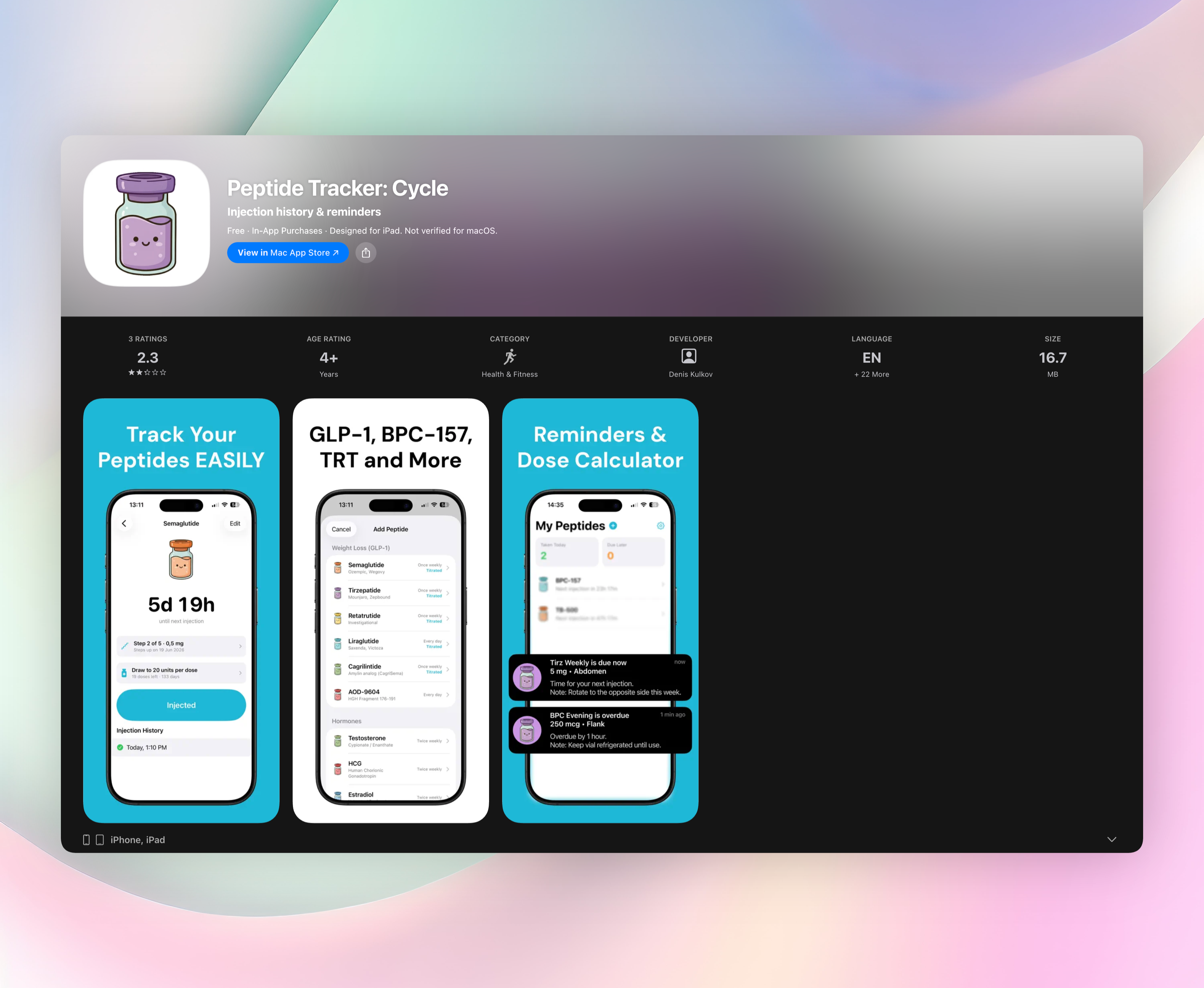
Those times then need to live somewhere you'll see them, next to a record of what you actually did. Peptide Tracker is a peptide logging app for iPhone, which is one place to keep both.
How to read sig codes left to right
"Sig" comes from signa — Latin for "write" or "label." It's the directions line, and sig codes are the compressed slots inside it. Read left to right:
amount → route → frequency → timing modifier → duration → condition
So 1 tab PO BID PC × 10 d unpacks to: one tablet, by mouth, twice a day, after meals, for ten days. That's the grammar of the line, not advice about any particular substance.
PRN attaches at the end with its trigger — PRN nausea reads "as needed for nausea." A PRN line is incomplete without both a trigger and a ceiling — "as needed" with no maximum can't be followed. Handwritten notes drop slots and leave the order to context, which is where misreadings start. The amount slot is where unit confusion lives; if you're squinting at mcg versus mg, the units on the label come before the frequency does.
Abbreviations you should read but never write
The Joint Commission publishes an official "Do Not Use" list for accredited organizations; the Institute for Safe Medication Practices keeps a longer error-prone list. The theme: these get misread by hand, and the misread changes the number.
- QD — the periods in q.d. are easily misread as the letter I, turning "once daily" into QID, four times a day. Write daily.
- QOD — collapses into QD or QID just as easily. Write every other day.
- U for unit — misread as a zero, a four, or cc, moving a number by a factor of ten or more. Write unit. If you measure on a barrel, be clear on what a unit is on an insulin syringe.
- IU — mistaken for IV or the number 10. Write international unit.
- HS — "at bedtime" or "half strength," depending on who's reading.
- SC, SQ, sub q — SC gets read as SL (sublingual), SQ as "5 every." ISMP recommends subcut or writing it out; the subcutaneous route is worth knowing precisely.
- µg — mistaken for mg. Write mcg.
- Zeros — 1.0 reads as 10 when the decimal fades; .5 reads as 5 with no leading zero. Write 1 and 0.5.
Shorthand is for decoding what someone else wrote. When you're the one writing the schedule, spell the frequency out.
FAQ
What does BID mean on a prescription label?
Twice a day. The label may add a timing modifier — BID AC is before meals, BID PC is after meals. BID alone gives the count and leaves the two clock times to you.
What does PRN mean in medical terms?
PRN is pro re nata, "as needed" — triggered by a symptom rather than by the clock. A complete PRN instruction names both the trigger and a daily maximum, and it can sit on the same line as a scheduled frequency.
What does q8h mean, and is it the same as TID?
q8h is every eight hours around the clock. TID is three times a day, usually within waking hours. The daily count matches; the spacing and the overnight requirement don't, so treat them as different instructions unless the source says otherwise.
Why do handwriting rules ban QD?
Because q.d. and q.i.d. look nearly identical in cursive, and confusing daily with four-times-daily is a fourfold change. QD appears on the Joint Commission's Do Not Use list for that reason; "daily" written in full has no lookalike.
What does "sig" mean on a prescription?
Sig is the directions line — from signa, "label" — the part printed for the person following it. Read the slots in order: amount, route, frequency, timing, duration, and any condition at the end.
Free Peptide tools
- BPC-157 & TB-500 Blend CalculatorEnter the BPC-157 and TB-500 amounts in your blended vial, the bacteriostatic water added and your desired BPC-157 dose. See the U-100 units, injection volume and TB-500 dose that comes with it.
- CJC-1295 Ipamorelin Blend CalculatorEnter the two peptide amounts in your blended vial, water added and the prescribed dose for either peptide. See the U-100 units, volume, both delivered amounts and doses remaining.
- Half-Life CalculatorEnter a starting amount, half-life, elapsed time and an optional repeat-dose interval to calculate amount remaining and decay milestones.
- mcg to mL CalculatorEnter a concentration, desired dose and syringe size to calculate the volume to draw in mL, U-100 units, mcg and mg.
- mg to mcg ConverterConvert mg to mcg or mcg to mg instantly. This simple calculator shows the converted amount and common reference values without giving dosing advice.
- Peptide Dosage CalculatorEnter your vial strength, the bacteriostatic water you added and the dose you were prescribed. Get the exact number of U-100 syringe units to draw, the injection volume and how many doses the vial holds.
- Semaglutide Units to mg CalculatorConvert prescribed semaglutide syringe units to mg, or a prescribed mg dose to U-100 units, using your vial details.
- Tirzepatide Unit CalculatorConvert your prescribed tirzepatide dose into U-100 syringe units, injection volume, concentration and doses remaining in the vial.