
What a peptide cycle is — and what washout, titration and stack mean
A peptide cycle is a bounded period of use — a defined start, a defined end — usually followed by an off-period called a washout. Neither word carries a length. They describe the shape of a schedule, not its contents.
What a peptide cycle actually describes
"Cycle" is borrowed vocabulary. Medicine uses it precisely in oncology, where treatment is delivered in repeating cycles of a treatment phase and a recovery phase. In peptide vernacular it's looser: use is bounded rather than continuous, and a gap follows the block.
That's the whole definition. A cycle specifies nothing about which substance, how much, how often, or why the gap exists — peptide cycling just means running something in blocks instead of open-endedly. What peptides are as a molecular class doesn't fill in the rest either.
The four scheduling words, side by side
| Term | What it describes | What it does not mean |
|---|---|---|
| Cycle | A bounded on-period, usually followed by an off-period | Not a dose, not a duration, not a rationale |
| Washout | The off-period, intended to let a substance clear | Not proof that every effect has reversed |
| Titration | Stepwise adjustment of an amount over time toward a target | Not necessarily an increase, and not a fixed step size |
| Stack | Two or more substances run in the same window | Not a claim that the combination does anything useful |
Washout periods and peptide half-life
A washout period is a deliberate gap in which nothing is administered. The term is at its most precise in clinical research: in a crossover trial, a participant takes one treatment, washes out, then takes the other, so the first doesn't contaminate the second period's results.
Outside trials, washouts are reasoned about in multiples of half-life. Half-life is the time it takes for the amount in the body to fall by half, and it compounds: one half-life leaves 50%, two leaves 25%, three 12.5%, four about 6%, five about 3%. The curve never reaches zero, so four or five half-lives is treated as the negligible threshold by convention, not a measured endpoint.
That only produces a number once you know which half-life applies. Peptide half-lives span orders of magnitude: native peptides are often broken up by peptidases within minutes, while analogs are engineered to resist that — fatty-acid acylation, albumin binding, PEGylation — moving clearance from minutes to days.
What half-life does not predict
Half-life describes concentration. It doesn't describe effect, and the two come apart routinely.
- Effects can outlast the molecule. A downstream change — receptor regulation, protein synthesis, tissue turnover — runs on its own schedule once the substance is gone.
- Effects can lag it, too. Some endpoints move slowly enough that levels reach steady state long before the outcome does.
- Accumulation mirrors this. With repeated administration, levels build until input matches elimination — reaching steady state takes roughly the same four to five half-lives.
- A reported half-life isn't one number. Terminal, effective, and population-specific figures can differ substantially.
None of this says whether a washout is needed or what it accomplishes. Those are clinical questions, not arithmetic.
Why peptide cycle length isn't a number you'll find here
Peptide cycle length depends on the compound, why it's being used, what's being monitored, and the judgment of whoever is responsible for the plan. This site doesn't set any of those, and numbers that circulate without provenance get copied far more often than they get sourced.
What titration means in medical use
Titration is stepwise adjustment over time. The word comes from chemistry, where a reagent is added in increments until an endpoint is reached, and medical use keeps the idea: change the amount in defined steps, check the response between steps, stop at the target.
Two details matter when you're reading a titration schedule.
Direction isn't fixed. Up-titration approaches a target from below. Down-titration — a taper — moves away from one. The word alone doesn't tell you which is meant.
The interval is part of the instruction. A titration has step sizes and step intervals chosen around how long the effect takes to appear — compressing it changes what was written.
What a peptide stack is
A stack is more than one substance run in the same window. The term comes from supplement and gym vernacular rather than clinical writing, and it describes scheduling rather than pharmacology — calling two things a stack asserts only that their periods overlap.
The consequences are mostly logistical. Each item is another vial with its own storage requirement, its own reconstitution date if it arrived lyophilized, and its own beyond-use window once mixed. Overlapping schedules are also where records fall apart fastest — a week later, the entries stop being distinguishable from memory.
Reading a schedule you were given
A schedule decomposes into five slots: what, how much, how often, between which dates, and what follows the end date. If one is blank, that's a question for whoever wrote it — not a gap to fill from a forum.
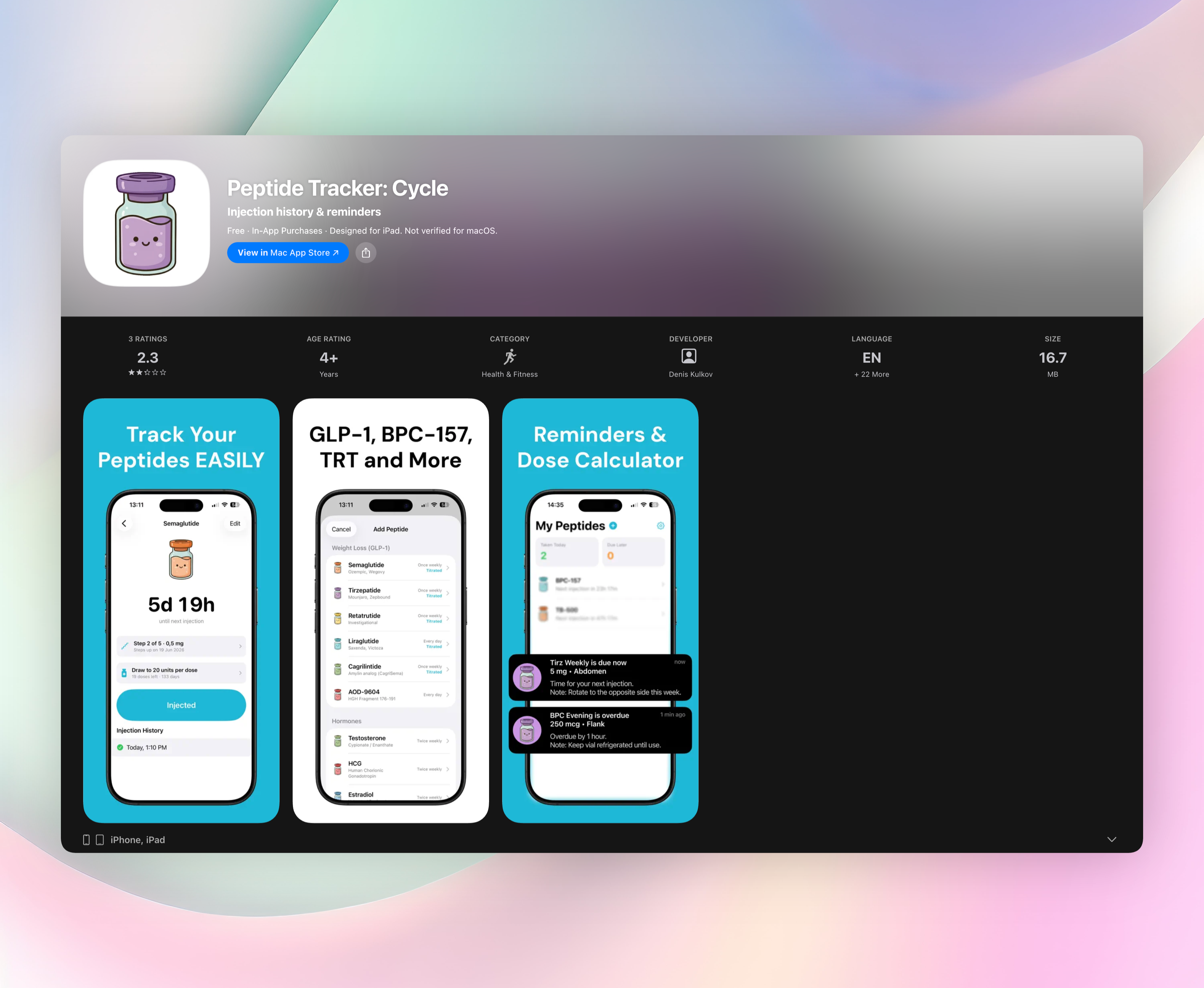
A cycle with a defined start, end and washout is a shape that can be written down once and then simply followed. Peptide Tracker, a peptide logging app for iPhone, is built around that shape: the schedule goes in once, and the daily question becomes what the schedule says rather than what you remember.
FAQ
What is a washout period?
An interval with no administration, intended to let a substance clear before the next phase begins. In clinical trials it has a formal job: separating treatment periods so the first doesn't carry into the second. Its length is reasoned about in multiples of half-life.
What is a peptide stack?
Two or more substances run over the same period. The term describes overlap in the schedule and nothing more — it makes no claim about how the substances interact, and whether a combination is appropriate is a clinical decision.
How many half-lives does it take to clear a substance?
By convention, four to five. Four half-lives leave roughly 6% of the original amount, five about 3% — the curve never reaches exactly zero, so it's a convention, not a measurement.
What does titration mean in medical use?
Adjusting an amount in defined steps over time, checking the response between steps, until a target is reached. It can run in either direction — a taper is a down-titration. The step sizes and intervals come from whoever wrote the schedule.
Does a longer half-life mean a longer effect?
Not reliably. Half-life describes how quickly concentration falls, while effects can outlast the molecule or lag behind it depending on what it sets in motion.
Free Peptide tools
- BPC-157 & TB-500 Blend CalculatorEnter the BPC-157 and TB-500 amounts in your blended vial, the bacteriostatic water added and your desired BPC-157 dose. See the U-100 units, injection volume and TB-500 dose that comes with it.
- CJC-1295 Ipamorelin Blend CalculatorEnter the two peptide amounts in your blended vial, water added and the prescribed dose for either peptide. See the U-100 units, volume, both delivered amounts and doses remaining.
- Half-Life CalculatorEnter a starting amount, half-life, elapsed time and an optional repeat-dose interval to calculate amount remaining and decay milestones.
- mcg to mL CalculatorEnter a concentration, desired dose and syringe size to calculate the volume to draw in mL, U-100 units, mcg and mg.
- mg to mcg ConverterConvert mg to mcg or mcg to mg instantly. This simple calculator shows the converted amount and common reference values without giving dosing advice.
- Peptide Dosage CalculatorEnter your vial strength, the bacteriostatic water you added and the dose you were prescribed. Get the exact number of U-100 syringe units to draw, the injection volume and how many doses the vial holds.
- Semaglutide Units to mg CalculatorConvert prescribed semaglutide syringe units to mg, or a prescribed mg dose to U-100 units, using your vial details.
- Tirzepatide Unit CalculatorConvert your prescribed tirzepatide dose into U-100 syringe units, injection volume, concentration and doses remaining in the vial.