
Intramuscular vs subcutaneous injection: the four real differences
Intramuscular vs subcutaneous injection comes down to which tissue the drug lands in. A subcutaneous injection goes into the fat layer just under the skin; an intramuscular one goes into the muscle belly beneath it. That single difference sets the needle, the angle, and how fast the drug absorbs.
What subcutaneous means
Break the word apart: sub (under) and cutaneous (skin). The subcutaneous layer — the hypodermis — sits between the dermis and the fascia that wraps muscle. It's loose connective tissue and fat, sparsely vascularized compared with muscle, which slows absorption.
The usual sites are wherever there's a dependable pinch of fat: the abdomen (away from the navel), the outer thigh, the back of the upper arm, the upper outer buttock. Layer thickness varies between people and between sites on one person, which is why rotation matters — see subcutaneous injection sites and rotation.
What intramuscular means
An intramuscular injection is deposited inside a muscle belly, most often the deltoid, the vastus lateralis on the outer thigh, or the ventrogluteal site on the hip. The needle has to cross the skin and the entire subcutaneous layer to get there — the whole reason IM needles are built longer. Muscle is dense, well-perfused tissue with an extensive capillary bed, and it accommodates a larger volume than the subcutaneous space does.
Intramuscular vs subcutaneous injection: the four real differences
| Subcutaneous | Intramuscular | |
|---|---|---|
| Target tissue | Fat and connective tissue under the skin | Muscle belly beneath the fascia |
| Common sites | Abdomen, outer thigh, back of upper arm | Deltoid, vastus lateralis, ventrogluteal |
| Typical needle length | ~4–16 mm (3/16 to 5/8 in) | ~25–38 mm (1 to 1.5 in) in adults |
| Typical gauge | 25G–31G | 22G–25G |
| Angle | 45° or 90°, set by needle length and tissue depth | 90°, perpendicular to the skin |
| Absorption | Slower, flatter | Faster |
| Abbreviation | SubQ, subcut, SC, SQ | IM |
Needle length and gauge
A needle only needs to be long enough to clear the skin and stop in the target tissue. Subcutaneous work uses short, fine ones — pen needles run roughly 4–8 mm, insulin syringes commonly carry a 6–12.7 mm needle in the 29G–31G range, and subcutaneous vaccine doses are often given with a 5/8-inch (16 mm) needle. More on matching length to site: needle size for subcutaneous injection.
IM needles run longer and wider: about 1 to 1.5 inches in adults, usually 22G–25G. Too short and the drug lands in fat instead of muscle; too long in a thin deltoid and it can reach bone.
Gauge tracks viscosity too: thick, oil-based formulations won't clear a 31G needle, another reason IM products use wider ones. Insulin syringes, for their part, are marked in units rather than milliliters.
Injection angle
Intramuscular is straightforward: 90°, perpendicular, skin held flat or displaced with the Z-track technique so the needle track seals behind it.
Subcutaneous has two answers. A short needle — a 4 or 6 mm pen needle, say — usually goes straight in at 90° without pinching. A longer needle, or a lean site, is typically given at 45° into a pinched fold so it stays out of muscle. The angle isn't a preference; it falls out of needle length versus tissue depth, and the product's instructions settle it.
Absorption speed
Muscle carries far more blood flow per gram than fat, so a drug deposited there meets capillaries sooner and reaches circulation faster. The subcutaneous space behaves more like a small depot, releasing gradually on a flatter curve. Heat or movement at the site speeds absorption from either route.
SubQ, SC, SQ: the abbreviation for subcutaneous injection
They all mean the same route. SubQ, sub-Q, subcut, SC, SQ, and s.c. are shorthand for subcutaneous. IM is intramuscular.
Some of those forms are discouraged in clinical writing because they've been misread in practice. The Institute for Safe Medication Practices keeps SC, SQ, and "sub q" on its list of error-prone abbreviations: SC has been mistaken for SL (sublingual), SQ read as "5 every," and the q in "sub q" taken for the Latin quaque, "every" — turning a route into a frequency. The recommended forms are "subcut" or the word spelled out. IM isn't on that list and is generally accepted.
The route is prescribed, not chosen
The subcutaneous vs intramuscular decision belongs to the product, not to the person holding the syringe. Route is part of a formulation's design, and the label and prescriber specify it. Swapping routes changes the absorption curve and, for some products, site tolerance.
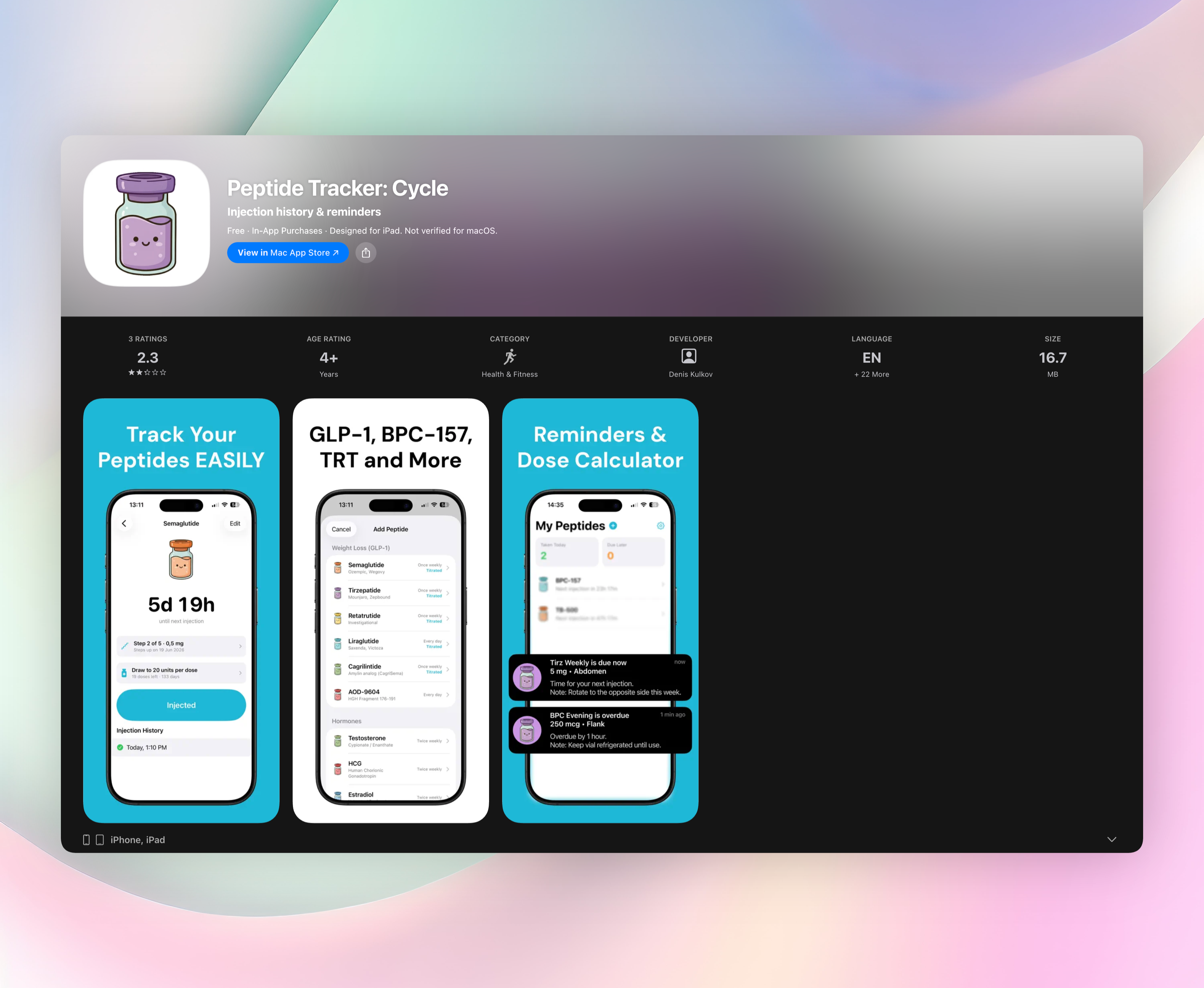
That's also why route deserves a field of its own in a record — site and amount don't describe what happened without it. Peptide Tracker, a peptide logging app for iPhone, keeps route alongside site and amount so each entry still reads as a complete record months later.
FAQ
What does subcutaneous injection mean?
It means the injection is placed in the subcutaneous layer — the fat and connective tissue between the skin and the muscle below it. "Sub" is under, "cutaneous" is skin. In practice it's a shallow injection given with a short, fine needle.
Is SubQ the same as SC and SQ?
Yes. All three are abbreviations for the same route. SC and SQ are discouraged in clinical writing because both have been misread as something else, so "subcut" or the full word is the safer thing to write down.
Which absorbs faster, intramuscular or subcutaneous?
Intramuscular, as a rule. Muscle is better vascularized than fat, so the drug reaches the bloodstream sooner. The subcutaneous route trades that speed for a slower, steadier release.
Can a subcutaneous injection be given at 90 degrees?
Yes, and often it should be. Very short needles are normally inserted at 90° with no skin fold. Longer needles, or sites with little tissue, are the case for 45° into a pinched fold.
How do I know which route a product uses?
You don't work it out — the prescription and the label state it, usually as IM or subcut. If the instruction is ambiguous, ask the prescriber or a pharmacist rather than inferring it from whatever needle came in the kit.
Free Peptide tools
- BPC-157 & TB-500 Blend CalculatorEnter the BPC-157 and TB-500 amounts in your blended vial, the bacteriostatic water added and your desired BPC-157 dose. See the U-100 units, injection volume and TB-500 dose that comes with it.
- CJC-1295 Ipamorelin Blend CalculatorEnter the two peptide amounts in your blended vial, water added and the prescribed dose for either peptide. See the U-100 units, volume, both delivered amounts and doses remaining.
- Half-Life CalculatorEnter a starting amount, half-life, elapsed time and an optional repeat-dose interval to calculate amount remaining and decay milestones.
- mcg to mL CalculatorEnter a concentration, desired dose and syringe size to calculate the volume to draw in mL, U-100 units, mcg and mg.
- mg to mcg ConverterConvert mg to mcg or mcg to mg instantly. This simple calculator shows the converted amount and common reference values without giving dosing advice.
- Peptide Dosage CalculatorEnter your vial strength, the bacteriostatic water you added and the dose you were prescribed. Get the exact number of U-100 syringe units to draw, the injection volume and how many doses the vial holds.
- Semaglutide Units to mg CalculatorConvert prescribed semaglutide syringe units to mg, or a prescribed mg dose to U-100 units, using your vial details.
- Tirzepatide Unit CalculatorConvert your prescribed tirzepatide dose into U-100 syringe units, injection volume, concentration and doses remaining in the vial.