
Peptide storage for lyophilized powder and reconstituted vials
Peptide storage depends on one thing: whether the peptide is still dry powder or already in solution. Lyophilized powder stays stable a long time when it's kept cold, sealed, and dark. Once a vial is reconstituted, it belongs in the refrigerator and has a clock running on it.
Why peptide storage splits into two sets of rules
A lyophilized peptide has been freeze-dried — water pulled off under vacuum, leaving a dry cake or a film so thin the vial can look empty. Dry stops most of the chemistry that degrades peptides. Hydrolysis needs water. Bacteria need water. In powder form the real threats are moisture, heat, and light.
Add water and all of it restarts. In solution the peptide is exposed to hydrolysis, oxidation moves faster, and the vial becomes somewhere organisms could grow if the diluent carries no preservative. That's why bacteriostatic water — sterile water with benzyl alcohol added — is the usual diluent for a vial that gets entered more than once.
So there's no single answer to how to store peptides. There are two, and they barely overlap.
Storing lyophilized peptides
Dry powder travels well. Peptides routinely ship at ambient temperature with no cold pack, because a short excursion at room temperature does little measurable damage to a properly dried, sealed vial. That tolerance is why shipping works. It isn't permission to keep the vial on a shelf.
Beyond the near term the standard is cold and dark: a freezer around -20 °C (-4 °F), colder for extended storage. Refrigeration at 2–8 °C (36–46 °F) is the normal middle ground for material you'll open soon. Manufacturers state their own temperature and duration, and that statement governs the specific product in front of you.
Let a cold vial warm up before opening it. Lyophilized peptide is hygroscopic — it pulls moisture out of the air. Open a chilled vial in a warm room and water condenses inside, and the powder starts taking it up. Leaving the vial on the counter for 20–30 minutes first costs nothing.
Don't shuttle vials in and out of the freezer. Every round trip is another condensation event. Keep the stock frozen and move one vial to the refrigerator when it's next in line.
Do peptides need to be refrigerated?
For a sealed powder vial, the honest answer is that cold is better and brief room temperature is usually survivable. Plenty of storage statements list a room-temperature window measured in days or weeks alongside a much longer refrigerated or frozen figure. Those numbers aren't in conflict; they describe different exposures.
For a reconstituted vial the answer is just yes. Once water is in, the vial lives at 2–8 °C between uses. Warmth speeds degradation, and in a multi-dose vial it also gives anything introduced at the stopper a better place to grow.
How long do reconstituted peptides last
Blanket numbers do the most damage here. Stability in solution depends on the sequence, the concentration, the diluent, and how the vial is handled, and the spread across products is wide enough that one figure for all of them means nothing. Refrigerated reconstituted material is generally described in weeks rather than months — but the number that applies to your vial is the one in its documentation.
Two clocks run at once, and most people watch only one:
- Potency. How much intact peptide remains. The loss is gradual and invisible; nothing about the vial announces it.
- Preservative window. How long the diluent keeps suppressing growth after the stopper has been punctured repeatedly. Bacteriostatic water is bacteriostatic, not sterilizing.
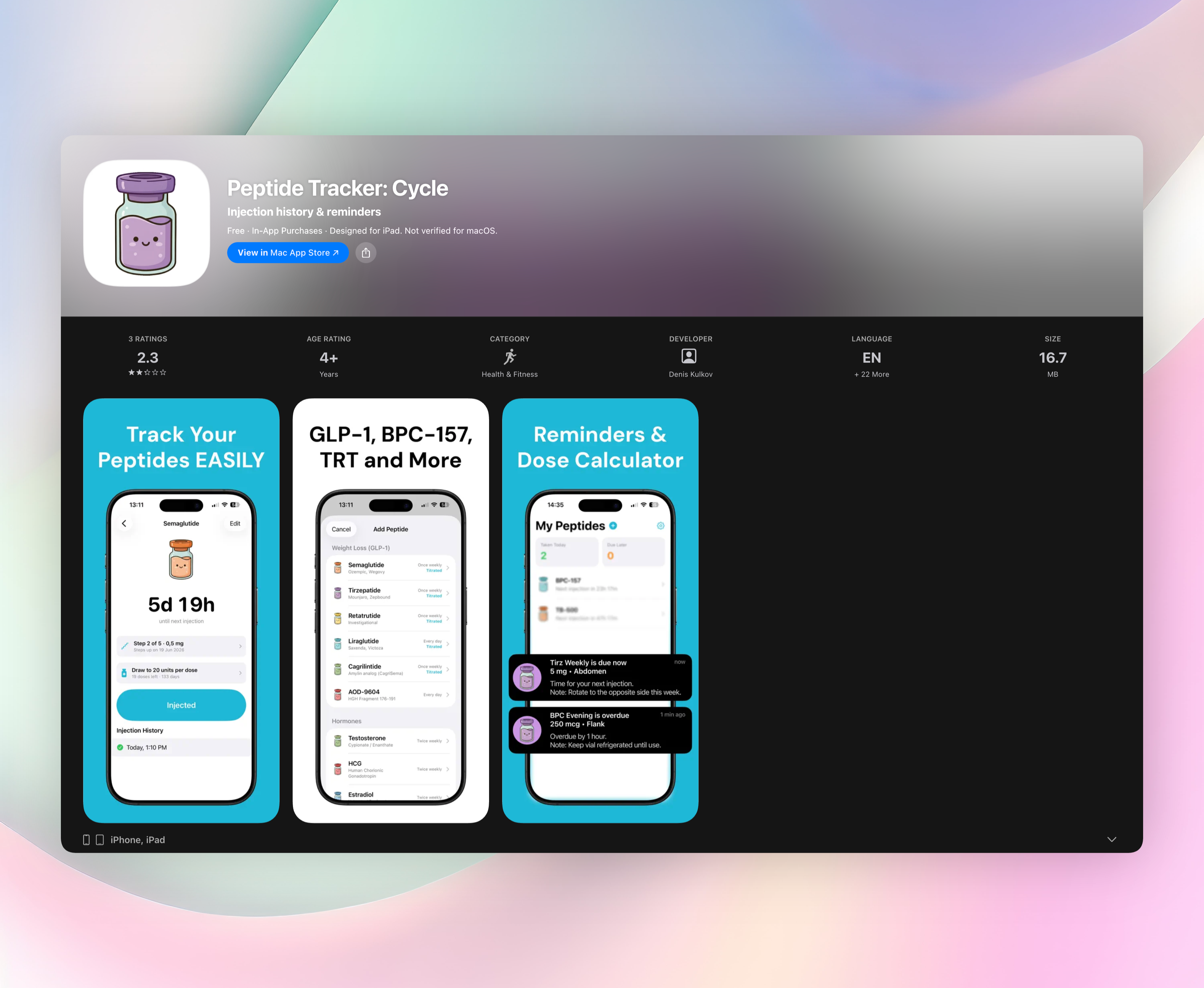
Both clocks start when you reconstitute the vial, not when you bought it — powder can sit comfortably inside its printed expiry while the solution made from it is months old. Peptide Tracker is a peptide logging app for iPhone, and recording the reconstitution date when you mix makes the age of an opened vial something you look up instead of something you try to remember.
Can you freeze peptides?
Powder, yes — that's the standard long-term method. Solution, generally no.
Freezing a solution isn't a neutral pause. As water freezes, ice crystals form and the peptide gets pushed into the shrinking unfrozen fraction, where it sits far more concentrated than intended and can aggregate. Crystal surfaces also give the molecule an interface to unfold against. Thawing reverses the temperature, not the damage, and each freeze–thaw cycle adds to whatever the last one did. That's why labs that must freeze a peptide solution divide it into single-use aliquots first: one freeze, one thaw, no repeats.
A home freezer makes it worse. Frost-free models run defrost cycles that deliberately swing the compartment temperature, so "frozen" isn't a steady state. Freezing also resets no clock — the vial that comes out is exactly as old as the vial that went in.
The same warning applies inside the refrigerator. Keep reconstituted vials off the back wall and away from the cold-air vent, which is where a "refrigerated" item quietly freezes solid.
Lyophilized vs reconstituted storage at a glance
| Lyophilized powder | Reconstituted solution | |
|---|---|---|
| Long-term storage | Freezer, around -20 °C, sealed | Not a long-term form |
| Refrigerator, 2–8 °C | Fine, and typical for near-term use | Required, between every use |
| Room temperature | Tolerated briefly; check the label | Only the minutes it's out |
| Freezing | Standard practice | Avoid — ice crystals and freeze–thaw damage |
| Clock that governs | Printed expiration date | Date you reconstituted it |
The door shelf is the worst place in the refrigerator
The door is the warmest and least stable part of a refrigerator. It meets room air every time the door opens, it holds the least thermal mass, and it swings through the widest temperature range of any shelf — the same reason food-safety guidance keeps milk and eggs off it. A vial that needs 2–8 °C belongs toward the back of a middle shelf, in its carton so it isn't shoved around.
Light and heat deserve the same care. Residues like tryptophan, methionine, cysteine, and tyrosine are the most prone to oxidation and photodegradation, so keeping the vial boxed is real protection, not a formality. A parked car in summer is a common way a vial gets cooked.
What a peptide shelf life statement actually tells you
A useful storage statement has two parts: a temperature and a duration. A temperature alone says where to put the vial, not how long it holds there; a duration alone is worthless without the condition it assumed. Every peptide shelf life figure rests on an assumed storage condition and stops applying the moment that condition does.
If a compounding pharmacy dispensed the vial, the beyond-use date on its label is the operative number, and it can be far shorter than a raw-material storage figure. Where a manufacturer's statement and a general rule of thumb disagree, the manufacturer's statement wins.
FAQ
Do peptides need to be refrigerated before they're mixed?
Cold is preferred for sealed lyophilized powder and does the most to extend usable life. Short periods at room temperature — shipping, a day on the counter — usually cost little. Follow the temperature and the duration the manufacturer states for that product.
How long do peptides last in the fridge?
Sealed powder at 2–8 °C is typically described in months, with freezing supporting longer. A reconstituted vial's refrigerated window is much shorter and usually described in weeks. The number that counts comes from the product's storage statement or the beyond-use date on a pharmacy label.
Can you freeze peptides after reconstitution?
Best avoided. Ice crystal formation, concentration of the peptide in the unfrozen fraction, and repeated freeze–thaw cycles all degrade the molecule, and freezing doesn't extend the preservative window. If a solution truly has to be frozen, single-use aliquots hold it to one cycle.
What happens if a reconstituted vial is left out overnight?
Nothing you can see. Degradation is gradual, so a warm night produces no cloudiness and no obvious signal — it just costs potency. Get the vial back to 2–8 °C and treat excursions as cumulative rather than forgivable.
Free Peptide tools
- BPC-157 & TB-500 Blend CalculatorEnter the BPC-157 and TB-500 amounts in your blended vial, the bacteriostatic water added and your desired BPC-157 dose. See the U-100 units, injection volume and TB-500 dose that comes with it.
- CJC-1295 Ipamorelin Blend CalculatorEnter the two peptide amounts in your blended vial, water added and the prescribed dose for either peptide. See the U-100 units, volume, both delivered amounts and doses remaining.
- Half-Life CalculatorEnter a starting amount, half-life, elapsed time and an optional repeat-dose interval to calculate amount remaining and decay milestones.
- mcg to mL CalculatorEnter a concentration, desired dose and syringe size to calculate the volume to draw in mL, U-100 units, mcg and mg.
- mg to mcg ConverterConvert mg to mcg or mcg to mg instantly. This simple calculator shows the converted amount and common reference values without giving dosing advice.
- Peptide Dosage CalculatorEnter your vial strength, the bacteriostatic water you added and the dose you were prescribed. Get the exact number of U-100 syringe units to draw, the injection volume and how many doses the vial holds.
- Semaglutide Units to mg CalculatorConvert prescribed semaglutide syringe units to mg, or a prescribed mg dose to U-100 units, using your vial details.
- Tirzepatide Unit CalculatorConvert your prescribed tirzepatide dose into U-100 syringe units, injection volume, concentration and doses remaining in the vial.