
IU to mg: why the conversion differs for every substance
There's no universal IU to mg conversion. An International Unit measures biological activity, not mass, so the milligram equivalent is defined separately for each substance against its own reference standard. A factor that's correct for one compound is meaningless for another.
What IU stands for, and what it actually measures
IU stands for International Unit. It's a unit of activity: the amount of a substance that produces an agreed biological effect when measured against an official reference preparation. That's the international units meaning in one line — what the material does in an assay, not how much of it sits on a balance.
The unit exists because biology once ran ahead of chemistry. Vitamins, hormones and antitoxins were used medically long before anyone could purify them or describe their structure, and two batches of the same extract could weigh the same yet behave differently. Defining potency against a shared physical standard fixed that: everyone's "one unit" did the same thing, even when nobody knew the mass. That history is why the IU meaning in medical labeling still clings to older, biologically assayed products, while newer well-characterized compounds are labeled by mass.
Why there's no universal IU to mg conversion
Activity per milligram is a property of the substance. Published equivalences make the point:
- Vitamin D3 (cholecalciferol): 1 IU = 0.025 mcg, so 1 mcg = 40 IU.
- Vitamin A: 1 IU = 0.3 mcg of retinol.
- Vitamin E: 1 IU = 0.67 mg of the natural RRR-alpha-tocopherol form, but 0.45 mg of the synthetic all-rac form. Same vitamin, two factors, because the isomer mixtures differ in activity.
- Somatropin: the WHO-adopted factor is 1 mg = 3 IU.
Across those four the numbers span orders of magnitude, and vitamin E manages two factors inside a single vitamin. A calculator offering one "IU to mg" box without asking which substance you mean is broken by design.
Purity matters too: a cleaner preparation carries more activity per milligram, which is why the factor is pinned to a defined standard rather than to the chemical in the abstract — and why it can be revised when a new standard replaces the old one.
Where the IU numbers come from
WHO's Expert Committee on Biological Standardization establishes International Standards: physical batches of freeze-dried material sealed into ampoules and sent to laboratories, with the UK's NIBSC a long-standing custodian. The IU is the activity in a stated quantity of that specific batch, and manufacturers calibrate their product against it — historically by bioassay, increasingly by validated physicochemical methods.
Two consequences follow. When a standard's stock runs low, a replacement batch is calibrated against the outgoing one, so continuity is the goal but the reference material isn't literally the same forever. And national units aren't automatically IU: pharmacopoeial units such as USP units have matched the IU for some substances and differed for others until deliberately harmonized.
IU, mg, mcg and syringe units compared
| Unit | What it measures | Typically seen on | Converts to mg? |
|---|---|---|---|
| IU | biological activity against a WHO reference standard | vitamins, some hormones, antitoxins, heparin | only via a substance-specific factor |
| mg | mass | most lyophilized peptide vials | it is mass |
| mcg (µg) | mass, one-thousandth of a mg | small quantities, vitamin panels | 1,000 mcg = 1 mg, always |
| syringe "unit" | volume — a mark on the barrel | insulin syringes | no; on a U-100 barrel one unit is 0.01 mL |
Three different things here get called "units", and only one is an IU. A mark on an insulin syringe is a volume: a U-100 barrel spreads 100 marks across 1 mL, so one mark holds 0.01 mL — 10 microliters. U-40 and U-500 barrels exist too, so how many units are in 1 mL depends on the barrel in your hand.
The mcg-to-mg step is the table's only clean conversion, because both sides are mass: 1 mg is 1,000 mcg for every substance that has ever existed.
What this means on a peptide vial
Most lyophilized peptides are labeled in mg or mcg for a straightforward reason — no WHO International Standard exists for them, so no IU has ever been defined. There is nothing to convert. Where IU does appear here, it belongs to a compound with a long regulatory history and carries no meaning outside that compound.
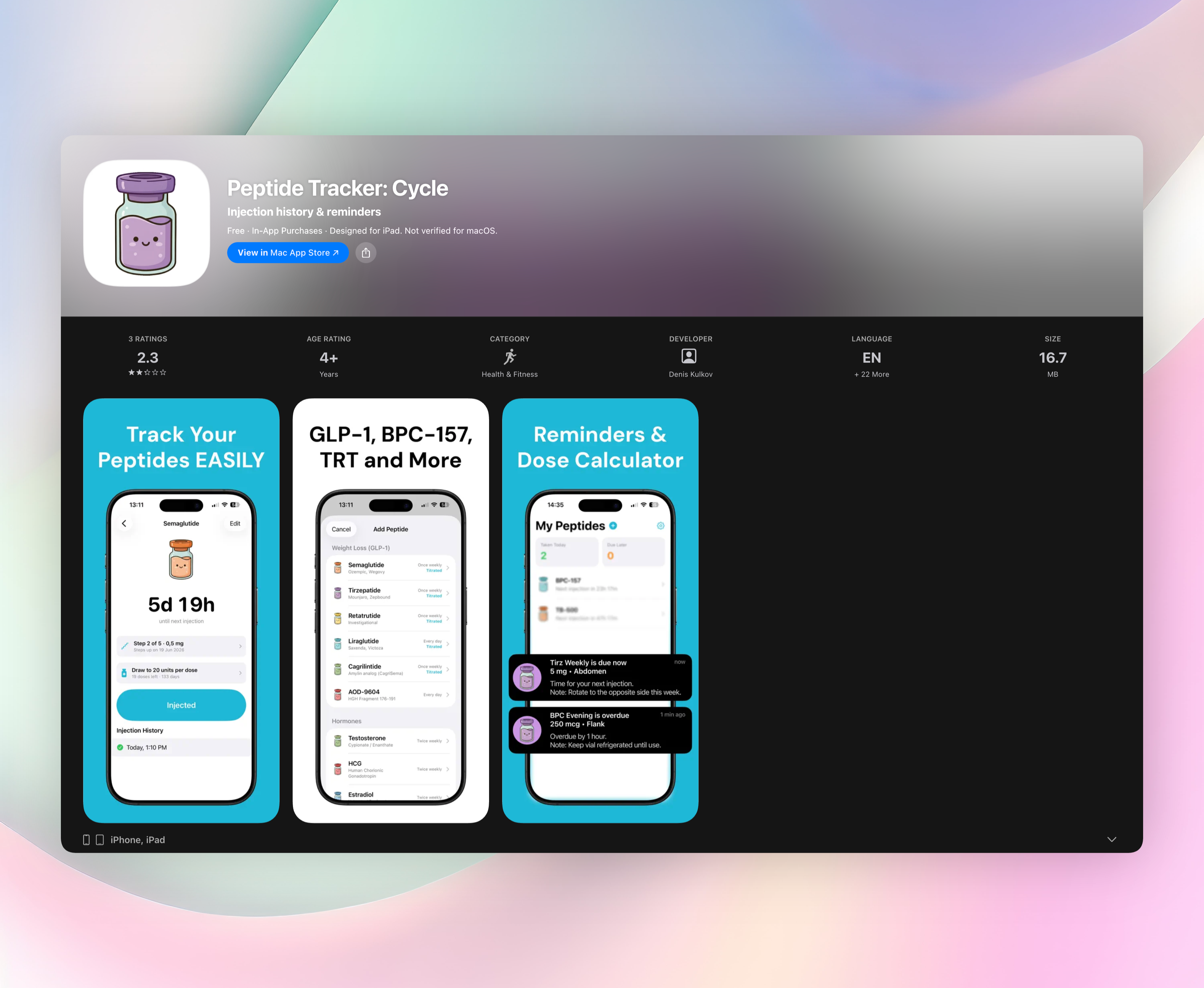
A practical habit follows: record the unit printed on the label, not a converted figure. Because the factor is substance-specific and revisable, a stored "IU" that began life as mg has quietly lost the one thing that made it checkable. Peptide Tracker is a peptide logging app for iPhone, and keeping entries in the label's own unit is what keeps that history auditable.
Reconstituting a vial doesn't change the mass sealed inside it, only how much liquid that mass is dissolved in. Mass, activity and volume are three separate questions, and a label usually answers just one.
FAQ
What does IU stand for?
International Unit. It measures biological activity against a WHO reference preparation, not weight or volume. The abbreviation is identical across substances; the quantity it stands for is not.
Is 1 IU the same as 1 mg?
No, and there's no fixed relationship between the two. Every substance with an IU has its own mass equivalence set by its reference standard — 1 IU of vitamin D is 0.025 mcg, while 1 IU of somatropin is about a third of a milligram.
Why do vitamin labels show both IU and mcg?
Nutrient labeling has been moving toward mass units, and mcg suits the amounts involved. Many products print both so shoppers who learned the old numbers still recognize what they're buying.
Are syringe units the same as IU?
No. A unit on an insulin syringe is a volume mark on the barrel, unrelated to biological activity. The two share a word and nothing else.
Can I trust an online IU to mg calculator?
Only if it names the exact substance and, where it matters, the exact form — the vitamin E factors differ between natural and synthetic versions. A generic converter with a single input box has no way to be right.
Free Peptide tools
- BPC-157 & TB-500 Blend CalculatorEnter the BPC-157 and TB-500 amounts in your blended vial, the bacteriostatic water added and your desired BPC-157 dose. See the U-100 units, injection volume and TB-500 dose that comes with it.
- CJC-1295 Ipamorelin Blend CalculatorEnter the two peptide amounts in your blended vial, water added and the prescribed dose for either peptide. See the U-100 units, volume, both delivered amounts and doses remaining.
- Half-Life CalculatorEnter a starting amount, half-life, elapsed time and an optional repeat-dose interval to calculate amount remaining and decay milestones.
- mcg to mL CalculatorEnter a concentration, desired dose and syringe size to calculate the volume to draw in mL, U-100 units, mcg and mg.
- mg to mcg ConverterConvert mg to mcg or mcg to mg instantly. This simple calculator shows the converted amount and common reference values without giving dosing advice.
- Peptide Dosage CalculatorEnter your vial strength, the bacteriostatic water you added and the dose you were prescribed. Get the exact number of U-100 syringe units to draw, the injection volume and how many doses the vial holds.
- Semaglutide Units to mg CalculatorConvert prescribed semaglutide syringe units to mg, or a prescribed mg dose to U-100 units, using your vial details.
- Tirzepatide Unit CalculatorConvert your prescribed tirzepatide dose into U-100 syringe units, injection volume, concentration and doses remaining in the vial.