
How many units in 1 mL on an insulin syringe barrel
How many units in 1 mL depends on the barrel, not on the liquid. On a U-100 insulin syringe, 1 mL is 100 units, which makes one unit 0.01 mL. On a U-40 barrel, that same 1 mL reads as 40 units.
How many units in 1 mL on a U-100 syringe
U-100 is a concentration standard: 100 units of insulin per milliliter. The syringe is manufactured to match it, so the "units" printed along the barrel are a volume scale wearing a different label. One unit is 0.01 mL — ten microliters. Converting 100 units to mL gives exactly 1 mL, 50 units gives 0.5 mL, 10 units gives 0.1 mL.
Two things follow from that. The ratio holds on every U-100 barrel, whether it tops out at 30 units or 100: a 0.3 mL syringe and a 1 mL syringe put their 20-unit marks at the same volume, 0.2 mL, just at different physical positions along the plastic. And the scale describes volume, nothing else. Draw a non-insulin liquid into a U-100 syringe and the 20 mark still means 0.2 mL, but it says nothing about how much substance sits in that 0.2 mL.
Insulin syringe sizes and what each barrel holds
Three capacities cover nearly everything sold. Manufacturers often print them as fractions on the wrapper — 3/10 mL, 1/2 mL.
| Barrel | Full scale (U-100) | Typical minor tick | Volume per minor tick |
|---|---|---|---|
| 0.3 mL (3/10 mL) | 30 units | 1 unit; half-unit models exist | 0.01 mL (0.005 mL) |
| 0.5 mL (1/2 mL) | 50 units | 1 unit | 0.01 mL |
| 1 mL | 100 units | 2 units; 1-unit models exist | 0.02 mL (0.01 mL) |
The practical difference between insulin syringe sizes is resolution. A 0.3 mL barrel spreads 30 marks over roughly the same length of plastic a 1 mL barrel uses for 100, so the ticks sit farther apart and small volumes are easier to land on. Graduations vary by manufacturer, so read the printed scale rather than assuming it from the capacity.
How to read an insulin syringe without guessing
- Read the scale name first. "U-100" or "100 units/mL" appears on the barrel, the plunger, or the wrapper. If no U rating is printed anywhere, it may not be a unit-marked insulin syringe at all.
- Find the numbered marks. They usually appear every 5 or 10 units, and they are not the small ticks.
- Count spaces, not lines. Take two adjacent numbers, subtract, then count the gaps between them. Ten units across five gaps means each tick is 2 units — 0.02 mL. This is the step people skip, and it's why a 1 mL barrel gets misread as though its ticks were single units.
- Read at the leading edge of the stopper, the flat front face of the rubber plunger tip, not its domed nose or its midpoint.
- Keep the barrel at eye level. Sighting down at an angle can shift the apparent mark by a tick or more.
U-40 vs U-100: the same number, a different volume
A mark labeled 20 is 0.2 mL on a U-100 barrel and 0.5 mL on a U-40 barrel — two and a half times the liquid for the same printed number. U-40 syringes remain common in veterinary medicine, and dedicated U-500 syringes exist for U-500 insulin. The scales are not interchangeable, and none of them is "the" unit.
The general units to mL conversion is straightforward: mL = units ÷ the scale's units per mL. Divide by 100 on a U-100 barrel, by 40 on a U-40 barrel. Reverse it to go the other way.
One more source of confusion: a 1 mL tuberculin syringe is graduated in milliliters, commonly every 0.01 mL. Each of those minor ticks happens to equal one U-100 unit of volume, which is why the two can look interchangeable in a photo and aren't in a drawer.
Units on the barrel vs IU on the label
An IU — international unit — is a potency measure. It's defined against a reference standard for one specific substance and describes biological activity, not volume or mass, so there is no universal IU-to-mg or IU-to-mL conversion. It differs per substance.
Insulin is the case that muddies this. Insulin quantity is expressed in units of activity, and the U-100 barrel is calibrated so one of those activity units occupies 0.01 mL. The two meanings line up by design there, and essentially nowhere else. For a lyophilized powder labeled in milligrams or micrograms — see how mcg and mg differ on a vial label — the barrel's marks are pure volume, and how much substance a mark contains depends entirely on the concentration created when diluent was added.
Turning a concentration into a barrel mark
The arithmetic is two steps, and both describe volume and concentration only — never how much of anything to use. Concentration comes first: the total amount in the vial divided by the milliliters of bacteriostatic water added, which gives an amount-per-mL figure. Change the diluent volume and that figure changes, even though the physical volume marks etched on the barrel never move.
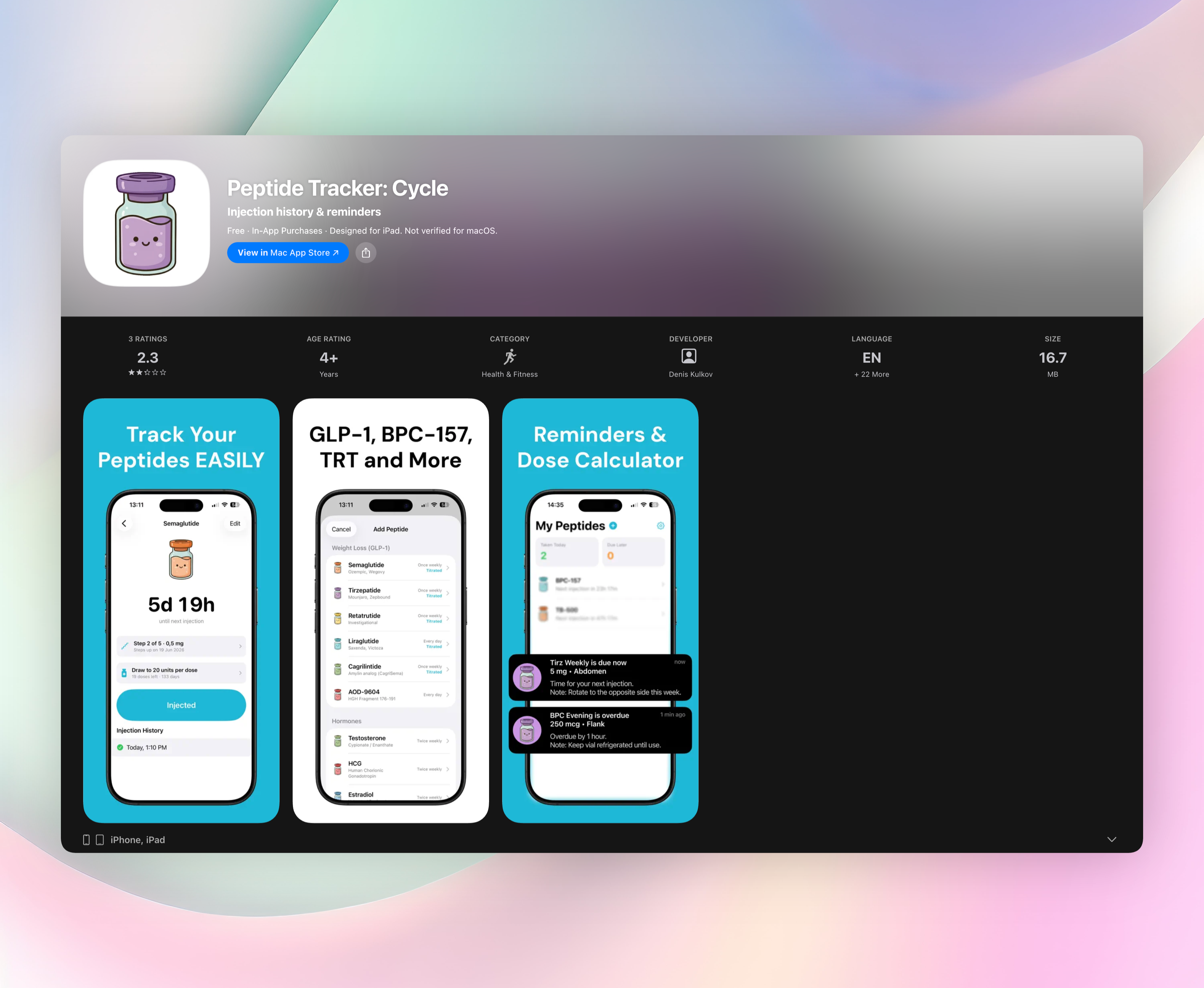
Then volume: whatever amount is being represented, divided by that concentration, multiplied by 100 to land on a U-100 unit mark. None of this decides what belongs in the syringe; it only describes what a given mark holds. Peptide Tracker, a peptide logging app for iPhone, converts a recorded amount into syringe units for the concentration you actually mixed, so the barrel gets read rather than recalculated each time.
FAQ
How many units are in 1 mL on an insulin syringe?
100, on a U-100 syringe — the standard scale for human insulin. That puts one unit at 0.01 mL. On a U-40 syringe, 1 mL is 40 units instead, and the barrel will say so.
Is 1 unit always 0.01 mL?
Only on a U-100 scale. On U-40 a unit is 0.025 mL, and on U-500 it's 0.002 mL. Check the U rating printed on the barrel before converting insulin syringe units to mL.
How many units does a 0.5 mL insulin syringe hold?
50 units on a U-100 scale, typically marked in 1-unit steps. The 0.3 mL size holds 30 units and the 1 mL size holds 100.
Why does my 1 mL syringe skip numbers?
Most 1 mL insulin syringes are numbered every 10 units with minor ticks worth 2 units each, because 100 individually numbered marks won't fit legibly on the barrel. Count the gaps between two numbers to confirm the step on the syringe in front of you.
Can I use an insulin syringe to measure something that isn't insulin?
The volume markings stay accurate — 20 units is 0.2 mL regardless of contents. What stops being meaningful is the word "units," because it only corresponds to potency for U-100 insulin. For anything else, treat the scale as a volume scale in 0.01 mL steps.
Free Peptide tools
- BPC-157 & TB-500 Blend CalculatorEnter the BPC-157 and TB-500 amounts in your blended vial, the bacteriostatic water added and your desired BPC-157 dose. See the U-100 units, injection volume and TB-500 dose that comes with it.
- CJC-1295 Ipamorelin Blend CalculatorEnter the two peptide amounts in your blended vial, water added and the prescribed dose for either peptide. See the U-100 units, volume, both delivered amounts and doses remaining.
- Half-Life CalculatorEnter a starting amount, half-life, elapsed time and an optional repeat-dose interval to calculate amount remaining and decay milestones.
- mcg to mL CalculatorEnter a concentration, desired dose and syringe size to calculate the volume to draw in mL, U-100 units, mcg and mg.
- mg to mcg ConverterConvert mg to mcg or mcg to mg instantly. This simple calculator shows the converted amount and common reference values without giving dosing advice.
- Peptide Dosage CalculatorEnter your vial strength, the bacteriostatic water you added and the dose you were prescribed. Get the exact number of U-100 syringe units to draw, the injection volume and how many doses the vial holds.
- Semaglutide Units to mg CalculatorConvert prescribed semaglutide syringe units to mg, or a prescribed mg dose to U-100 units, using your vial details.
- Tirzepatide Unit CalculatorConvert your prescribed tirzepatide dose into U-100 syringe units, injection volume, concentration and doses remaining in the vial.