
Converting mcg to mg on a peptide label
One milligram is 1000 micrograms. To convert mcg to mg, divide by 1000; to go the other way, multiply by 1000. On a peptide label that single factor of 1000 is the whole problem: the vial is marked in mg, while amounts get discussed in mcg.
How to convert mcg to mg (and back)
The metric mass ladder steps by 1000 at every rung, not by 10 or 100:
- 1 g = 1000 mg
- 1 mg = 1000 mcg
- 1 mcg = 1000 ng
So the arithmetic is always a three-place decimal shift:
- mcg to mg: divide by 1000, move the decimal three places left. 500 mcg = 0.5 mg.
- mg to mcg: multiply by 1000, move it three places right. 0.25 mg = 250 mcg.
The substance is irrelevant: a milligram of lyophilized powder and a milligram of water are both 1000 mcg.
Why labels write "mcg" and not "µg"
The SI symbol for microgram is µg: the Greek letter mu, standing for one millionth. "mcg" isn't part of the SI system at all — it's a spelling that exists for safety.
Handwritten, or rendered by a system with a broken character set, µ degrades into something that reads as m — and µg misread as mg is a thousandfold error. US medication-safety guidance has discouraged µ in written orders for decades, and pharmacy and supplement labelling followed. You'll also see "ug" where software couldn't print mu. All three mean the same unit.
Peptide vials are labelled in mg, amounts are talked about in mcg
A vial of lyophilized peptide carries one quantity: the total mass of powder sealed inside, in milligrams. It describes the container, not how the contents get divided up. Most of the rest of a peptide vial's label is identity, lot, and storage.
Once liquid goes in, the working figure becomes a concentration in milligrams per mL, which is where the milligram-to-microgram step shows up and part of why reconstitution math trips people up. The amounts written down afterward are almost always in micrograms — one reference in mg, the other in mcg, every comparison crossing three decimal places.
mcg to mg conversion table
Read left to right for micrograms to milligrams, right to left for the reverse.
| Micrograms (mcg) | Milligrams (mg) |
|---|---|
| 25 mcg | 0.025 mg |
| 50 mcg | 0.05 mg |
| 100 mcg | 0.1 mg |
| 200 mcg | 0.2 mg |
| 250 mcg | 0.25 mg |
| 500 mcg | 0.5 mg |
| 750 mcg | 0.75 mg |
| 1,000 mcg | 1 mg |
| 1,500 mcg | 1.5 mg |
| 2,000 mcg | 2 mg |
| 2,500 mcg | 2.5 mg |
| 5,000 mcg | 5 mg |
| 10,000 mcg | 10 mg |
| 15,000 mcg | 15 mg |
| 20,000 mcg | 20 mg |
| 30,000 mcg | 30 mg |
The larger rows are the range printed on vial labels; the smaller ones are what those contents look like in micrograms.
The two mistakes that cause 1000× errors
Reading µg as mg
If a label or spec sheet shows µg and you read mg, everything downstream is off by a factor of 1000. The check is containment: a figure in micrograms should convert to a fraction of the vial's stated milligram total. If it exceeds the whole vial, you read the wrong unit.
Moving the decimal the wrong way
Converting to a larger unit always produces a smaller number — 500 mcg becomes 0.5 mg. If your mcg to mg conversion returned 500,000, you multiplied where you should have divided. The rule holds in reverse: milligrams up to micrograms always gives a bigger number.
Two writing habits catch most decimal slips. Always write the leading zero (0.5 mg, never .5 mg) and never write a trailing zero (5 mg, never 5.0 mg). Both come from the same safety tradition that retired µ: a missing decimal point is a tenfold error nobody notices.
A 10-second sanity check
Estimate the order of magnitude first, then check the arithmetic against it. Whole-vial masses sit in single or double-digit milligrams; quantities expressed in micrograms usually land in the hundreds or low thousands. If a result is three digits from where you expected, you slipped a factor of 1000 — the only error size this conversion produces.
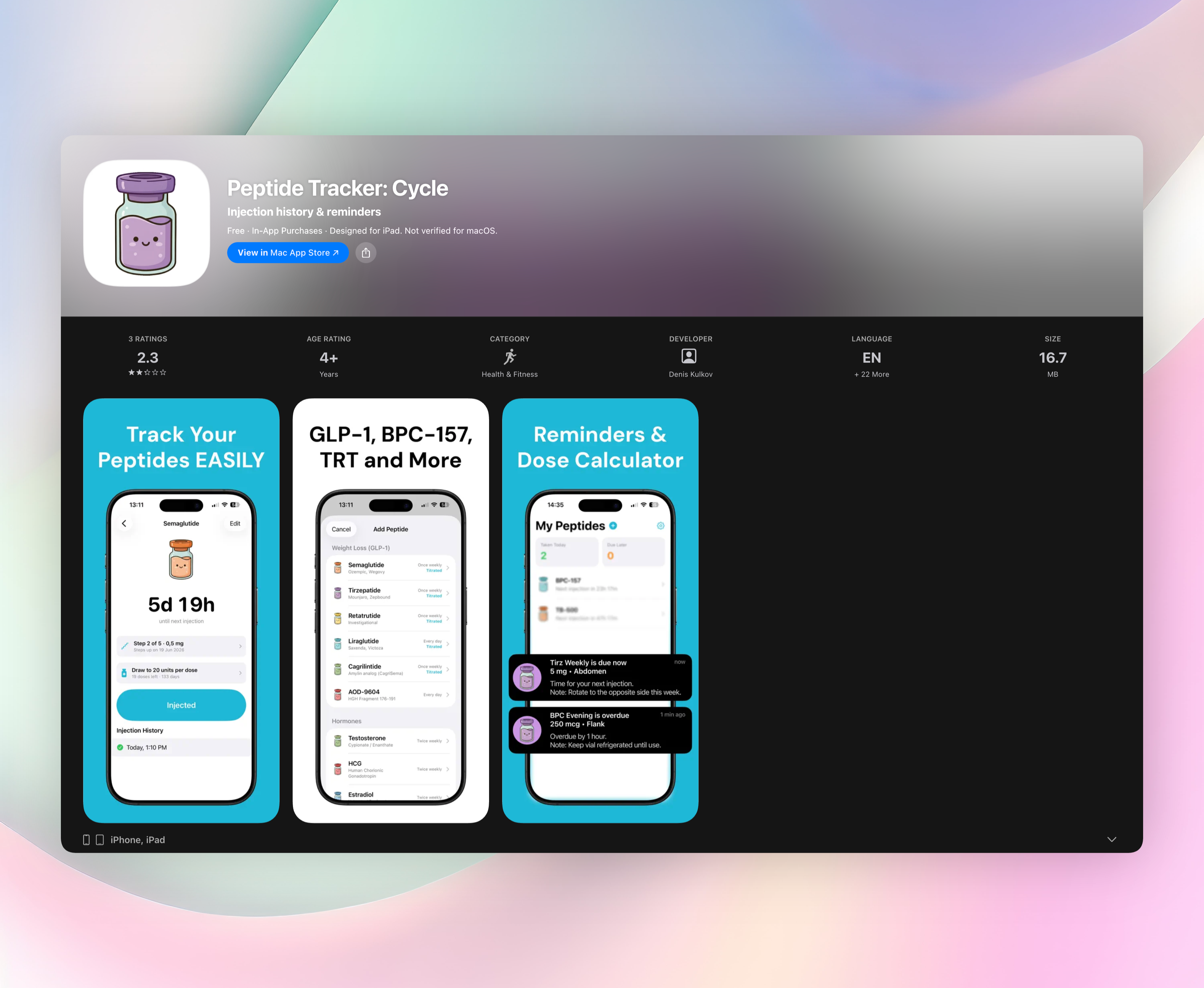
The conversion only has to happen once. If a vial's total goes in as milligrams at setup and every entry afterward uses one consistent unit, no arithmetic is left to get wrong later. Peptide Tracker, a peptide logging app for iPhone, stores a single unit per peptide and converts for display for that reason.
FAQ
How many mcg in a mg?
- A milligram is one thousandth of a gram and a microgram one millionth, so a milligram holds exactly 1000 micrograms. The ratio is fixed and never depends on what's being weighed.
How many mcg in 1 mg of a peptide?
Still 1000 — how many mcg in 1 mg is a question about units, not substances. One milligram of lyophilized powder is 1000 micrograms of it. What varies between peptides is how many milligrams a vial holds, not the conversion factor.
Is mcg the same as µg?
Yes. µg is the SI symbol, mcg is the spelled-out version used where the mu character is risky or unavailable, and ug appears when a system can't render mu at all. All three mean microgram, one millionth of a gram.
How do I convert mg to mcg in my head?
Move the decimal point three places right: 0.5 mg becomes 500 mcg, 2 mg becomes 2000 mcg. Going the other way, move it three places left. If the digit count didn't change by three, the shift was wrong.
Why do peptide vials list mg when amounts are given in mcg?
The label states the total mass of powder in the container, and that total is a tidy figure in milligrams — micrograms would put five-digit numbers on every vial. The mismatch exists because the label describes a whole container while everything downstream describes a portion of it.
Free Peptide tools
- BPC-157 & TB-500 Blend CalculatorEnter the BPC-157 and TB-500 amounts in your blended vial, the bacteriostatic water added and your desired BPC-157 dose. See the U-100 units, injection volume and TB-500 dose that comes with it.
- CJC-1295 Ipamorelin Blend CalculatorEnter the two peptide amounts in your blended vial, water added and the prescribed dose for either peptide. See the U-100 units, volume, both delivered amounts and doses remaining.
- Half-Life CalculatorEnter a starting amount, half-life, elapsed time and an optional repeat-dose interval to calculate amount remaining and decay milestones.
- mcg to mL CalculatorEnter a concentration, desired dose and syringe size to calculate the volume to draw in mL, U-100 units, mcg and mg.
- mg to mcg ConverterConvert mg to mcg or mcg to mg instantly. This simple calculator shows the converted amount and common reference values without giving dosing advice.
- Peptide Dosage CalculatorEnter your vial strength, the bacteriostatic water you added and the dose you were prescribed. Get the exact number of U-100 syringe units to draw, the injection volume and how many doses the vial holds.
- Semaglutide Units to mg CalculatorConvert prescribed semaglutide syringe units to mg, or a prescribed mg dose to U-100 units, using your vial details.
- Tirzepatide Unit CalculatorConvert your prescribed tirzepatide dose into U-100 syringe units, injection volume, concentration and doses remaining in the vial.