
Does bacteriostatic water need to be refrigerated?
No. Bacteriostatic water doesn't need to be refrigerated — an unopened vial is stored at controlled room temperature, 20–25 °C (68–77 °F). The date that catches people isn't the printed expiration; it's the shorter in-use window that starts the moment the stopper is first punctured.
Does bacteriostatic water need to be refrigerated?
No, and the fridge buys you nothing. "Controlled room temperature" is a defined USP storage condition: 20–25 °C (68–77 °F), with brief excursions between 15 °C and 30 °C (59–86 °F) tolerated. A cupboard away from a window or radiator meets that easily.
Refrigeration isn't on the label, and it doesn't extend the preservative's working life once the vial is open. It also adds a nuisance: a cold vial pulled out repeatedly collects condensation on the stopper, which is the opposite of what you want on a surface you're about to swab and puncture.
One temperature rule is absolute — don't freeze it. Water expands as it freezes, and that expansion stresses the closure and the glass. A vial that froze in a delivery truck or an unheated garage gets discarded, even if it looks fine thawed.
What the benzyl alcohol is actually doing
Bacteriostatic Water for Injection, USP is sterile water with 0.9% benzyl alcohol (9 mg/mL) added. That one ingredient is the entire reason the vial can be entered more than once — what separates it from plain sterile water is the preservative, nothing else.
Bacteriostatic means it holds bacterial growth in check. It does not mean sterilizing. Benzyl alcohol suppresses the small number of organisms a clean entry might introduce; it won't rescue a vial contaminated by an unswabbed stopper or a re-used needle, and it won't reverse growth already underway.
The preservative also has a working life inside an open vial. Every entry is a chance to introduce a stray organism, and repeated punctures wear on the septum. Benzyl alcohol's preservative effectiveness is validated only for a defined window after first entry — that tested window, not the water itself, is what the in-use limit protects. Products containing benzyl alcohol also carry a labeled caution against use in newborns, stated on the manufacturer's insert.
The two dates people conflate
Every vial carries a printed expiration. The moment you puncture it, a second and much shorter clock starts, and the two are set by different things.
| Printed expiration date | In-use window | |
|---|---|---|
| Starts | Date of manufacture | First puncture of the septum |
| Ends | The date stamped on vial and carton | Commonly 28 days later |
| Assumes | Vial unopened, stored as labeled | Vial stored as labeled between entries |
| Set by | The manufacturer's stability data | The manufacturer's in-use statement |
| Recorded on the vial by | The manufacturer | You, in marker |
Use whichever arrives first. A vial opened three weeks before its printed expiration is governed by that printed date; a vial opened eleven months early is governed by the 28 days.
How long does bacteriostatic water last after opening?
Twenty-eight days is the figure most manufacturers state, and it matches the standard beyond-use date applied to a multiple-dose container: 28 days after initial entry unless the labeling says otherwise. Your vial's insert wins over the general rule, so read it — some products specify something shorter.
Bacteriostatic water shelf life before opening is far longer. Unopened vials typically carry a dated expiration a year or more out, printed on both vial and carton, based on the manufacturer's stability data for that lot. Nothing you do at home extends it; storing as labeled is the only way to keep it valid.
How to store bacteriostatic water, step by step
- Keep it upright at controlled room temperature, in its carton, away from heat and direct sun. No fridge, no freezer.
- Write the open date on the label the first time you puncture the stopper. In marker, on the vial itself — not on a carton you'll throw out, and not in your head.
- Write the discard date beside it: open date plus 28 days, or the printed expiration, whichever is earlier.
- Swab the septum with 70% isopropyl alcohol before every entry and let it dry. A needle dragged through a still-wet septum defeats the point; the alcohol needs contact time.
- Use the smallest needle that works and shift the puncture point slightly each time. Repeated entries with a large-bore needle can core the rubber, dropping a fragment into the solution and leaving a channel that no longer reseals.
- Inspect before every use. The solution should be clear and colorless with nothing floating in it. Cloudiness, particles, discoloration, or a lifted or damaged stopper means discard.
- Never top one vial off from another or decant into an unlabeled container. You lose the date and double the contamination surface.
Where the diluent's dates meet the peptide's
Reconstituted vials are a separate storage question. Once a lyophilized powder is mixed, the resulting solution's stability is governed by the peptide rather than the diluent, and those are generally kept cold — peptide storage covers that side. The water vial keeps its own room-temperature rule and its own 28-day clock regardless of what you've drawn from it.
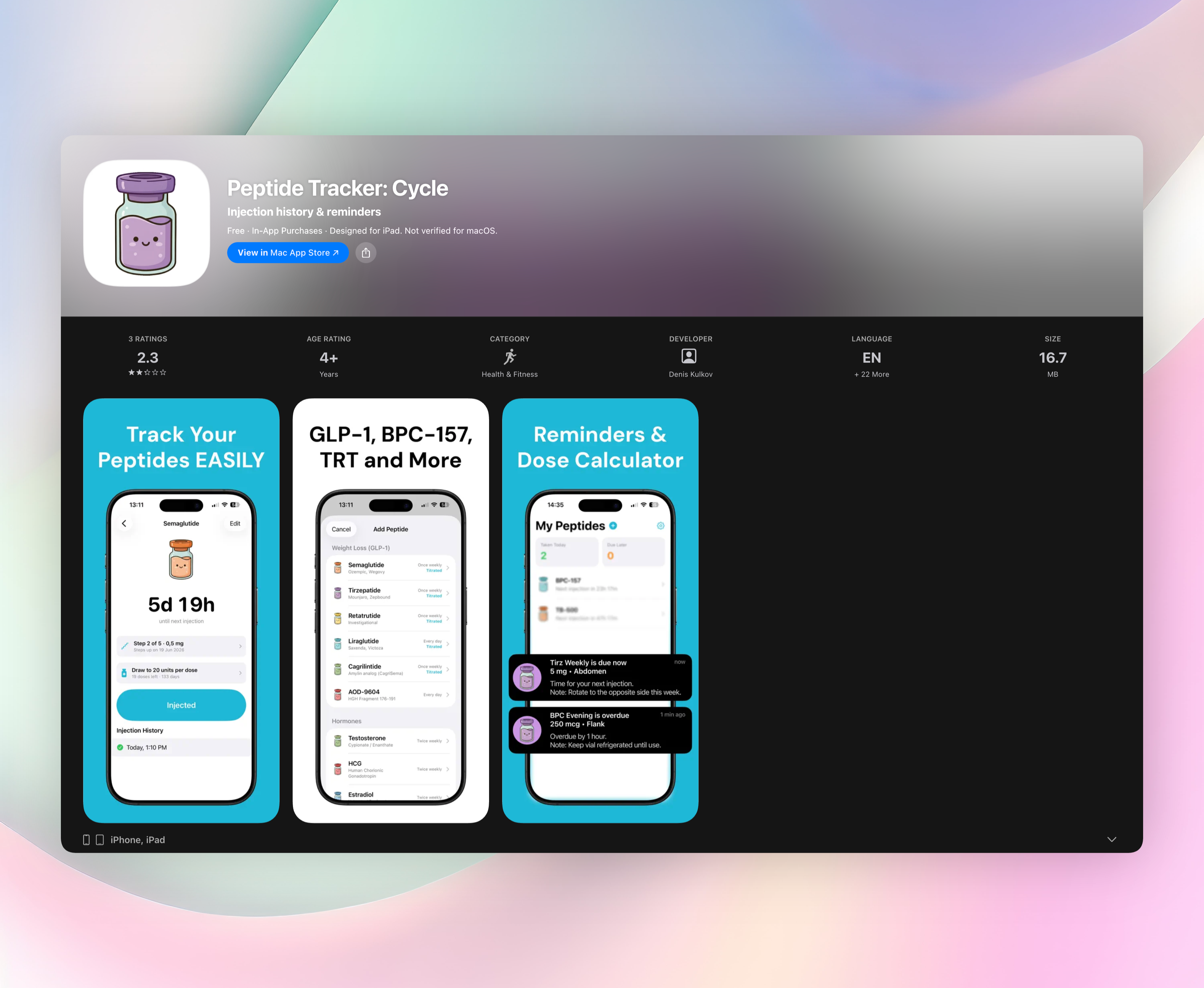
That leaves three dates running at once: the water's printed expiration, the water's open date, and the reconstituted vial's own window. Logging the diluent's open date in the same place as the peptide's dates is what makes the earliest of them the one you actually notice. Peptide Tracker, a peptide logging app for iPhone, is where I keep mine.
FAQ
Does bacteriostatic water need to be refrigerated after opening?
No. An opened vial goes back to the same controlled room temperature, 20–25 °C (68–77 °F). Chilling it doesn't extend the 28-day in-use window, and it encourages condensation on the stopper. The clock is set by the first puncture, not by temperature.
How long is bacteriostatic water good for after opening?
Most manufacturers state 28 days from first entry, which matches the standard beyond-use date for a multiple-dose container. If the vial's printed expiration falls sooner than day 28, that date wins instead.
Does bacteriostatic water expire if it's never opened?
Yes. Every vial carries a printed expiration set by the manufacturer. It applies only to an unopened vial stored as labeled, so it's void if the vial was frozen, left well outside the tolerated temperature range, or has a compromised stopper.
Can I keep using it past 28 days if it still looks clear?
No — clarity isn't a sterility test. Benzyl alcohol suppresses growth rather than guaranteeing sterility indefinitely, and contamination is invisible long before it isn't. The 28-day limit exists precisely because you can't see what it's protecting against.
What's the difference between bacteriostatic and sterile water for injection?
Sterile Water for Injection contains no preservative, so it's single-use: one entry, then the remainder is discarded. The benzyl alcohol in bacteriostatic water is what permits multiple entries from one vial, and it's also the reason there's a 28-day limit at all.
Free Peptide tools
- BPC-157 & TB-500 Blend CalculatorEnter the BPC-157 and TB-500 amounts in your blended vial, the bacteriostatic water added and your desired BPC-157 dose. See the U-100 units, injection volume and TB-500 dose that comes with it.
- CJC-1295 Ipamorelin Blend CalculatorEnter the two peptide amounts in your blended vial, water added and the prescribed dose for either peptide. See the U-100 units, volume, both delivered amounts and doses remaining.
- Half-Life CalculatorEnter a starting amount, half-life, elapsed time and an optional repeat-dose interval to calculate amount remaining and decay milestones.
- mcg to mL CalculatorEnter a concentration, desired dose and syringe size to calculate the volume to draw in mL, U-100 units, mcg and mg.
- mg to mcg ConverterConvert mg to mcg or mcg to mg instantly. This simple calculator shows the converted amount and common reference values without giving dosing advice.
- Peptide Dosage CalculatorEnter your vial strength, the bacteriostatic water you added and the dose you were prescribed. Get the exact number of U-100 syringe units to draw, the injection volume and how many doses the vial holds.
- Semaglutide Units to mg CalculatorConvert prescribed semaglutide syringe units to mg, or a prescribed mg dose to U-100 units, using your vial details.
- Tirzepatide Unit CalculatorConvert your prescribed tirzepatide dose into U-100 syringe units, injection volume, concentration and doses remaining in the vial.