
Subcutaneous injection sites and a rotation scheme that works
The standard subcutaneous injection sites are the abdomen, the outer upper arm, the front and outer thigh, and the upper outer buttock. Rotation means putting each injection somewhere different from the last, on a pattern you can reconstruct weeks later. It exists because injecting the same spot repeatedly changes the tissue underneath.
The four standard subcutaneous injection sites
Subcutaneous tissue is the fat layer between skin and muscle. It's loose, carries less blood flow than muscle, and absorbs slowly, which is the whole reason it's used. The same subcutaneous injection locations show up across insulin, heparin, fertility medication, and peptide instructions, because the anatomy doesn't change with the contents of the syringe.
Abdomen. The area between the lower ribs and the hip bones, front and sides, staying clear of the navel. Clearance guidance varies from about an inch to about two (2.5–5 cm); the wider margin is safer, since tissue near the navel is tougher and more fibrous. It's the largest usable area and the easiest to see.
Outer upper arm. The back and outer surface of the upper arm, between shoulder and elbow, where you can lift tissue away from the bone. Self-injecting your dominant arm is awkward, so it's often used with help or dropped from the rotation.
Front and outer thigh. A band down the front and outside of the thigh, roughly a hand's width below the hip and a hand's width above the knee. Stay off the inner thigh and away from the knee. It's visible sitting down, which makes it the region most people can manage alone.
Upper outer buttock. The upper, outer quadrant — high and toward the side, well away from the tailbone. There's plenty of subcutaneous fat there, but you can't see it, so it needs a mirror or another person.
Some references add the flank and upper back, though neither is reachable alone.
| Site | Boundaries | Self-injection | Watch for |
|---|---|---|---|
| Abdomen | Lower ribs to hip bones, clear of the navel | Easy | Waistband friction, old scar tissue |
| Outer upper arm | Shoulder to elbow, back and outer surface | Hard on the dominant side | Thin fat layer on lean arms |
| Front/outer thigh | Hip to knee, front and outer surface only | Easy | Inner thigh, area near the knee |
| Upper outer buttock | Upper outer quadrant, toward the side | Needs a mirror or help | You can't see the site |
What to keep off the map
Skip anything that isn't ordinary, intact skin over ordinary fat: scars, stretch-marked skin, moles, tattoos, bruises, and anything red, broken, or tender. Skip the belt line, where clothing rubs. Skip any lump or hardened patch you can feel, because that's the thing rotation exists to prevent and injecting into it makes it worse.
Rotation happens at two levels
Most people rotate between regions — abdomen this time, thigh next — and consider the job done. That's the coarse level, and it's the less important one.
The fine level is rotation within a region: spacing consecutive spots inside the abdomen, or inside one thigh, so the same square inch isn't used again for weeks. That's where tissue actually gets worn down.
There's a reason to keep the coarse level slow. Absorption rate differs by region; in the insulin literature the abdomen absorbs fastest, then the arm, then the thigh, with the buttock slowest, and exercising a limb speeds absorption from that limb. Hopping between regions changes that variable every time; staying in one and rotating inside it holds it steady.
Lipohypertrophy is the reason rotation exists
Lipohypertrophy is thickened, rubbery subcutaneous tissue that builds up where injections keep landing. Early on you can only feel it, as a firm patch that doesn't move like the fat around it. Later it can show as a raised, smooth swelling.
It's self-reinforcing. Affected tissue has fewer working nerve endings, so injecting there hurts less, so people keep choosing it. Absorption from that tissue meanwhile becomes slower and less predictable, which is the real problem: the same volume goes in and a different, unknowable amount comes out.
The fix is time. Left alone for months the tissue usually recovers, but only if the area is genuinely out of rotation. Anything you can feel is worth a clinician's look. The rarer opposite is lipoatrophy, a dent where subcutaneous fat has been lost.
A rotation scheme that survives real weeks
The scheme used in injection-technique guidance is a grid, not a guess.
- Divide each region. An imaginary cross through the navel splits the abdomen into four quadrants. Thighs and buttocks split into left and right, or upper and lower halves.
- Use one division at a time. Insulin guidance commonly assigns a quadrant per week and then moves clockwise to the next. Set the period to fit your own schedule, but change divisions on a fixed rule rather than by feel.
- Space the spots inside it. Keep roughly an inch (about 2.5 cm) between consecutive injections, working across the quadrant in a line or grid instead of drifting back toward the middle.
- Write down where it went. This is the step that makes the other three real.
Rotation is a memory problem before it's a technique problem. Across dozens of injections nobody reliably recalls which quadrant they were in three weeks ago, and unrecorded rotation drifts toward whichever spot is most comfortable — which is exactly the spot that's already thickening. If you log each dose in Peptide Tracker, a peptide logging app for iPhone, the site goes in with the entry, so the last few are something you read back rather than reconstruct.
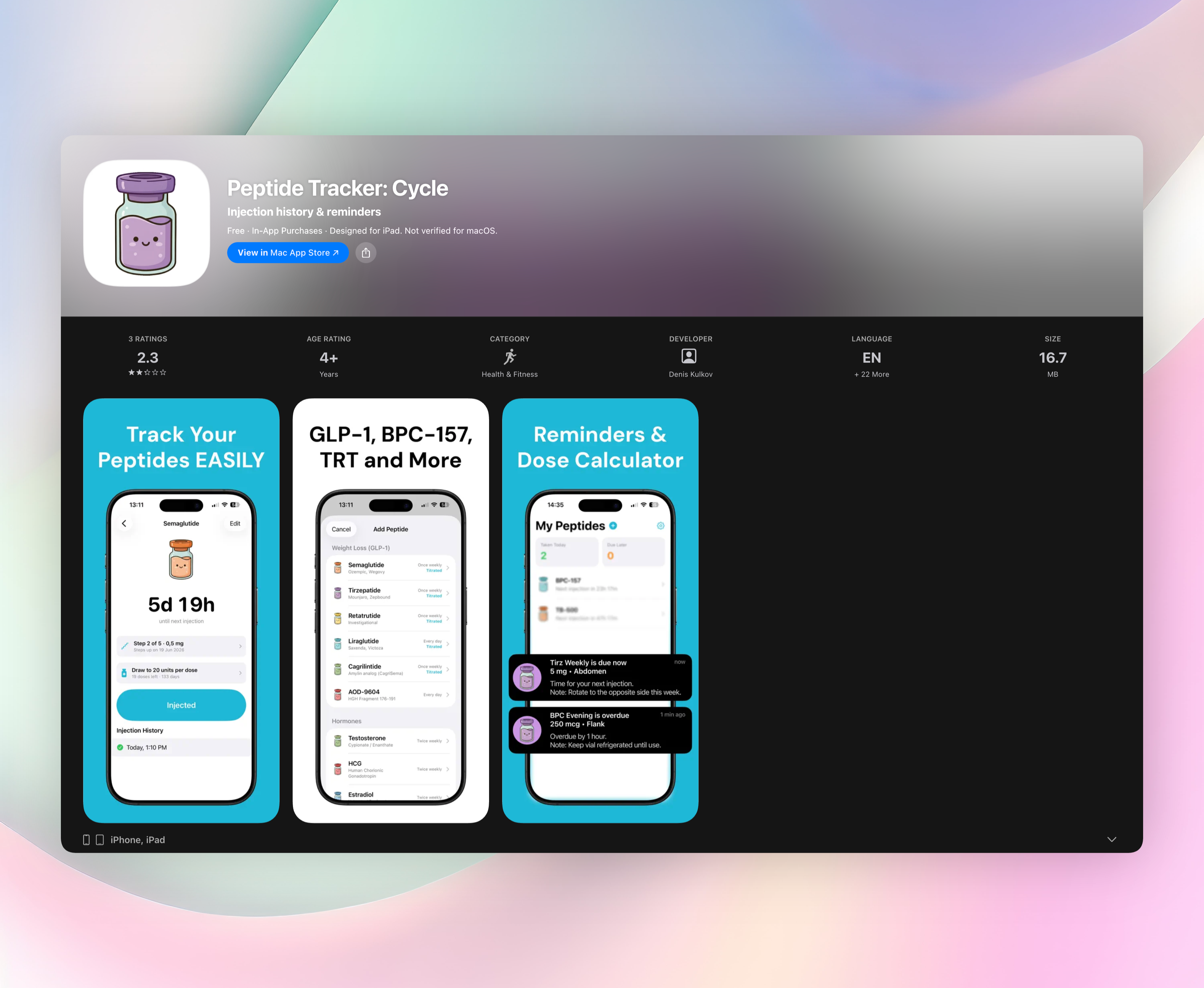
A dated paper body map does the same job. What doesn't work is remembering.
Subcutaneous injection angle and needle length
The subcutaneous injection angle isn't an independent choice. It follows from needle length and how much fat sits at the site. Short needles, the kind fitted to an insulin syringe, are generally used at 90 degrees. Longer needles, or lean sites where the fat layer is thin, are where 45 degrees and a lifted skin fold come in — pinching lifts fat away from the muscle so a longer needle stops in the right layer.
"Pinch up" and "skin fold" are the terms for that. Whether a fold is needed at all depends on the needle length and gauge and on the site, and these numbers get quoted as universal when they aren't. Angle, fold, and needle choice belong to the clinician who trained you. This is the map, not the technique.
FAQ
What are the best subcutaneous injection sites for self-injection?
The abdomen and the front and outer thigh, because you can see both and reach both without help. The outer upper arm and the upper outer buttock are equally valid anatomically but hard to use alone. Having two workable regions you rotate properly beats having four you rotate badly.
How far apart do consecutive injections need to be?
About an inch (2.5 cm) is the commonly cited minimum between one injection and the next. Distance is only half of it: the point is not returning to that square inch for weeks, which takes a written record.
Can you give every subcutaneous injection in the thigh?
Yes, but not the same part of it. Split the thigh into halves or quadrants and move through them on a fixed pattern, exactly as you would across the abdomen. A heavily reused patch develops lipohypertrophy regardless of which region it's in.
What angle is a subcutaneous injection given at?
Either 90 or 45 degrees, depending on needle length and how thick the fat layer is at that site. Short needles are typically used at 90 degrees, longer ones at 45 with the skin pinched into a fold. Whoever trained you sets which applies.
Where do you learn how to give a subcutaneous injection?
From the clinician who prescribed it and demonstrated the technique. Diagrams and subcutaneous injection sites pictures are useful for learning each region's boundaries and for planning a rotation grid, but they show where, not how, and they can't account for your own anatomy.
Free Peptide tools
- BPC-157 & TB-500 Blend CalculatorEnter the BPC-157 and TB-500 amounts in your blended vial, the bacteriostatic water added and your desired BPC-157 dose. See the U-100 units, injection volume and TB-500 dose that comes with it.
- CJC-1295 Ipamorelin Blend CalculatorEnter the two peptide amounts in your blended vial, water added and the prescribed dose for either peptide. See the U-100 units, volume, both delivered amounts and doses remaining.
- Half-Life CalculatorEnter a starting amount, half-life, elapsed time and an optional repeat-dose interval to calculate amount remaining and decay milestones.
- mcg to mL CalculatorEnter a concentration, desired dose and syringe size to calculate the volume to draw in mL, U-100 units, mcg and mg.
- mg to mcg ConverterConvert mg to mcg or mcg to mg instantly. This simple calculator shows the converted amount and common reference values without giving dosing advice.
- Peptide Dosage CalculatorEnter your vial strength, the bacteriostatic water you added and the dose you were prescribed. Get the exact number of U-100 syringe units to draw, the injection volume and how many doses the vial holds.
- Semaglutide Units to mg CalculatorConvert prescribed semaglutide syringe units to mg, or a prescribed mg dose to U-100 units, using your vial details.
- Tirzepatide Unit CalculatorConvert your prescribed tirzepatide dose into U-100 syringe units, injection volume, concentration and doses remaining in the vial.