
Needle size for subcutaneous injection: gauge and length
Needle size for subcutaneous injection is two separate numbers: gauge, which is the shaft's outer diameter, and length. Gauge runs backwards — 31G is thinner than 27G. Length is stated in inches or millimeters, and subcutaneous work sits at the short end of the range.
Neither number implies the other, and they're specified for different reasons. What follows decodes the label. Which combination belongs in your hand is a question for the clinician who prescribed the injection.
Gauge runs backwards because it started as a wire count
Needle gauge inherits its numbering from the Birmingham (Stubs) wire gauge, an old system for describing drawn wire. Wire was thinned by pulling it through successively smaller dies, and the number roughly tracked how many passes it took. More passes, thinner wire, higher number. Hypodermic tubing borrowed the scale, and the inversion came with it.
So no property of the needle grows as the number grows. Gauge is a position on a legacy scale, not a measurement you can picture directly.
What the gauge number measures on a needle gauge chart
Gauge corresponds to the outer diameter of the tubing. ISO 9626 fixes a nominal outer diameter for each gauge, which is why a 30G from one manufacturer matches a 30G from another within tolerance. Any needle gauge chart you find is reproducing those same figures.
| Gauge | Outer diameter (mm) | Outer diameter (in) |
|---|---|---|
| 18G | 1.270 | 0.050 |
| 21G | 0.819 | 0.032 |
| 23G | 0.642 | 0.025 |
| 25G | 0.515 | 0.020 |
| 27G | 0.413 | 0.016 |
| 29G | 0.337 | 0.013 |
| 30G | 0.312 | 0.012 |
| 31G | 0.261 | 0.010 |
| 32G | 0.235 | 0.009 |
Notice how compressed the fine end is. The step from 18G to 21G removes about 0.45 mm of outer diameter; the step from 29G to 31G removes about 0.08 mm. Small numeric differences up top are large physical differences, and vice versa.
What gauge does not tell you is the bore. ISO 9626 defines more than one wall thickness, so a thin-wall needle has a wider inner channel than a regular-wall needle of the same gauge and moves fluid faster. Thin-wall products are usually marked as such. Hub color coding is also standardized, but it only helps with detachable needles — an insulin syringe has a permanently bonded needle and no colored hub to read.
Subcutaneous injection needle length is a separate specification
Length is measured from the hub face to the tip, excluding the hub. It gets printed in whichever unit the market expects, so the same needle can appear as 5/16" or 8 mm depending on the box.
- 5/32" ≈ 4 mm
- 15/64" ≈ 6 mm
- 5/16" = 7.94 mm, universally rounded to 8 mm
- 1/2" = 12.7 mm
- 1" = 25 mm
- 1 1/2" = 38 mm
Subcutaneous means the fat layer under the dermis and above the muscle, which is a shallow target, so lengths sold for that route cluster in the first four entries above. The longer entries belong to intramuscular work.
How needle size for subcutaneous injection appears on the package
A line like 31G x 5/16" is gauge first, length second. A third, unrelated number sits nearby: barrel volume, typically 0.3 mL, 0.5 mL, or 1 mL. On a U-100 insulin syringe the barrel is graduated in insulin units rather than milliliters, with 100 units to the milliliter — worth understanding separately, because unit markings and milliliters are not interchangeable.
That's why "a 31 gauge insulin syringe" is an incomplete description. It pins the shaft diameter and implies a unit-graduated barrel, but says nothing about length or capacity until you read the rest of the label.
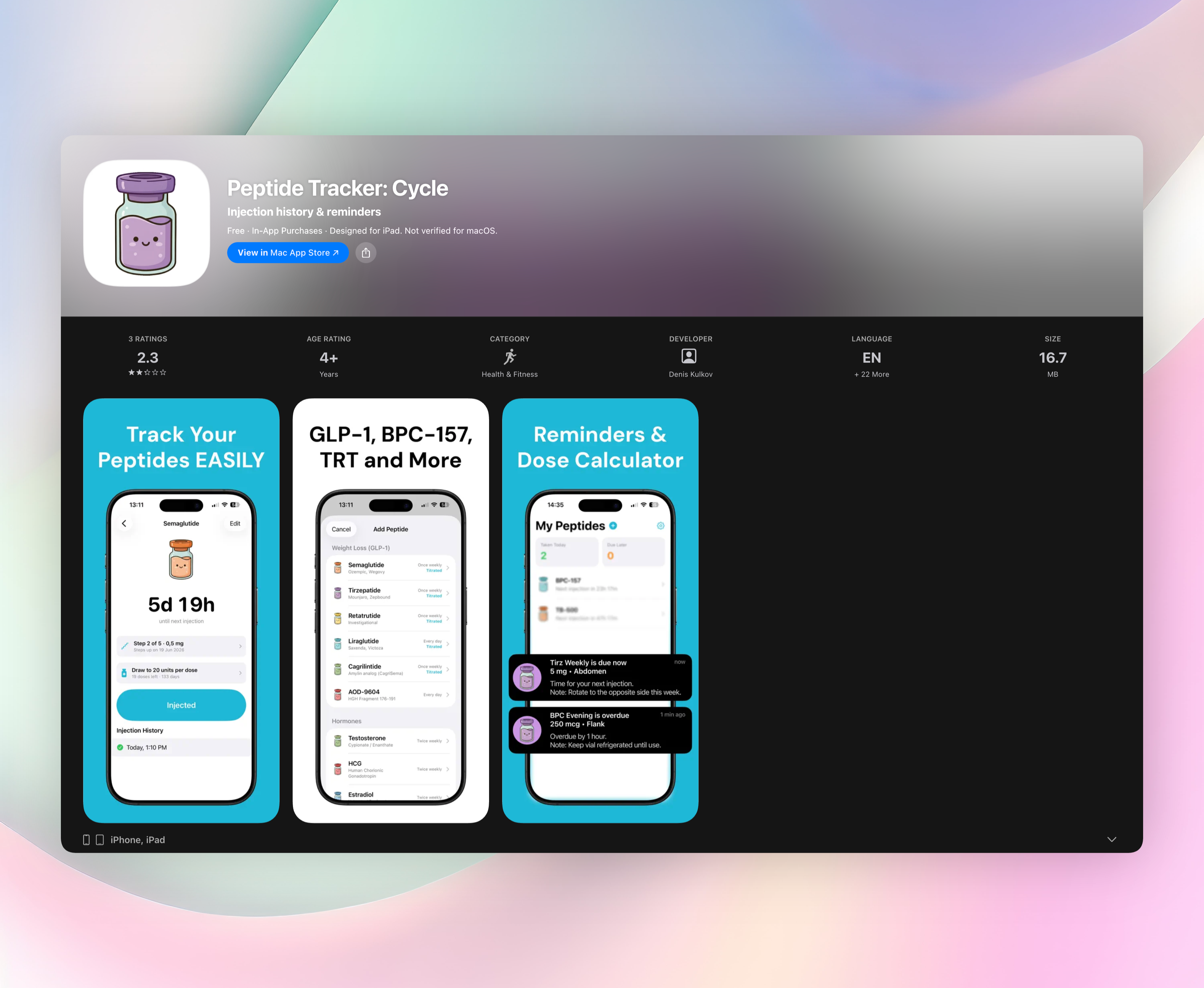
Those specs are also the ones people forget between orders. Recording gauge, length, and barrel volume alongside the rest of your supplies in Peptide Tracker, a peptide logging app for iPhone, means a reorder matches what's already in the drawer instead of what you half-remember.
Drawing through a septum is a different job than injecting
A shaft fine enough for shallow tissue is a poor pipe. Pushing diluent through a rubber stopper at 31G is slow, and viscous liquids are slower still, which is why many reconstitution kits pair a thicker transfer or blunt fill needle for the vial with a fine needle for the injection itself.
Detachable needles also carry dead space — the residual volume trapped in the hub and needle after the plunger bottoms out. Integrated-needle syringes hold very little by comparison. That difference matters whenever the drawn volume is small.
Coring, and why bore size shows up again
Coring is when the needle punches a fragment out of the vial's elastomeric stopper and drops it into the liquid. It usually appears as a floating speck. Wider bores, long sharp bevels, dulled tips, and repeated punctures through the same spot all raise the odds, which is one more reason the two jobs get separate needles.
The standard mitigation is technique: bevel facing up, enter at an angle rather than straight down, then rotate upright as the tip passes through, and vary the puncture site across the septum. Genuinely non-coring needles exist — the Huber point, designed for implanted ports — and they deflect the elastomer instead of cutting it. A standard hypodermic is not one of them.
FAQ
Does a higher gauge number mean a bigger needle?
No, the opposite. Higher gauge means a thinner shaft. A 31G needle has an outer diameter of about 0.26 mm; a 21G needle is about 0.82 mm, roughly three times thicker.
What gauge needle for subcutaneous injection is standard?
There isn't a single standard. Products sold for shallow self-injection concentrate at the fine end, but the specific gauge and length are prescribed with the medication, the site, and the person in mind. Follow whatever your clinician or the product's instructions specify rather than a general rule.
What's the real difference between a 29G and a 31G?
About 0.08 mm of outer diameter, plus whatever the wall thickness contributes to the bore. The finer shaft moves fluid more slowly and is more easily bent or dulled; the thicker one fills and empties faster.
Are inch and millimeter length labels different products?
No. 5/16" and 8 mm describe the same needle — 5/16" is 7.94 mm, rounded for the label. Only the unit on the box changes between markets.
Can one needle both draw and inject?
Physically yes with a detachable needle, but the tip dulls on the stopper and coring risk rises with each pass. Kits that include two needles are separating the two jobs deliberately.
Free Peptide tools
- BPC-157 & TB-500 Blend CalculatorEnter the BPC-157 and TB-500 amounts in your blended vial, the bacteriostatic water added and your desired BPC-157 dose. See the U-100 units, injection volume and TB-500 dose that comes with it.
- CJC-1295 Ipamorelin Blend CalculatorEnter the two peptide amounts in your blended vial, water added and the prescribed dose for either peptide. See the U-100 units, volume, both delivered amounts and doses remaining.
- Half-Life CalculatorEnter a starting amount, half-life, elapsed time and an optional repeat-dose interval to calculate amount remaining and decay milestones.
- mcg to mL CalculatorEnter a concentration, desired dose and syringe size to calculate the volume to draw in mL, U-100 units, mcg and mg.
- mg to mcg ConverterConvert mg to mcg or mcg to mg instantly. This simple calculator shows the converted amount and common reference values without giving dosing advice.
- Peptide Dosage CalculatorEnter your vial strength, the bacteriostatic water you added and the dose you were prescribed. Get the exact number of U-100 syringe units to draw, the injection volume and how many doses the vial holds.
- Semaglutide Units to mg CalculatorConvert prescribed semaglutide syringe units to mg, or a prescribed mg dose to U-100 units, using your vial details.
- Tirzepatide Unit CalculatorConvert your prescribed tirzepatide dose into U-100 syringe units, injection volume, concentration and doses remaining in the vial.