
Lipohypertrophy: why injection sites thicken, and how to rotate
Lipohypertrophy is a firm, rubbery thickening of the fat under the skin where injections land repeatedly in the same small area. It absorbs slowly and inconsistently, and it tends to hurt less than fresh tissue — which is exactly why people keep going back to it.
What lipohypertrophy is and how it forms
Subcutaneous fat is a layer of fat cells with a modest, even blood supply. Drive a needle through the same square inch a few hundred times and that layer remodels. Two inputs do it: mechanical trauma from the needle, and — with insulin specifically — a local growth signal, since insulin is anabolic and fat cells bathed in it enlarge. The result is a raised pad, sometimes several inches across, with normal-looking skin over it.
Nearly all of it was studied in insulin therapy, where people inject several times a day for decades. The trauma-and-remodeling half of the mechanism travels with any repeated subcutaneous injection; the insulin-specific half doesn't automatically transfer to every injectable. So "lipohypertrophy" names the classic insulin picture, while "injection-site nodule" or "induration" covers firm lumps at overused sites generally. Its opposite is lipoatrophy: a dent rather than a bump, immune-mediated and now rare.
Why thickened tissue keeps getting used
Sensation, mostly. Remodeled tissue has sparser nerve endings, so injecting there is comfortable — sometimes noticeably more so than the fat around it. That's a feedback loop: the more the spot is used, the thicker it gets; the thicker it gets, the less it hurts; the less it hurts, the more the hand returns to it.
The cost is absorption. Blood flow through remodeled tissue is reduced and irregular, so uptake is slow and varies day to day. Same technique, same volume, different result. That unpredictability is the real problem, not the cosmetic bump.
Finding it: look, then feel
Inspect in good light, then palpate — sight alone misses broad, shallow pads. Lay two or three fingers flat and sweep across the region, comparing left to right. Healthy fat feels soft and even; lipohypertrophy feels firmer and springier, with an edge you can trace. Repeat every few weeks, since it develops gradually.
A rotation scheme: quadrants, clockwise, an inch apart
Insulin injection site rotation teaching has settled on big-then-small: commit to a large region for a stretch, then move systematically inside it.
- Map the abdomen into four quadrants with an imaginary vertical line through the navel and a horizontal one across it. Stay clear of roughly a two-inch circle around the navel itself, where the tissue is tougher.
- Split each thigh into upper and lower halves on the front-outer face, staying about a hand's width below the groin and above the knee.
- Use one region per stretch — a week is the common teaching — then move to the next in a fixed clockwise order. Which order matters far less than never varying it.
- Move about an inch between consecutive injections, working across the region in a grid rather than drifting back toward its center. Formal guidance sets the bare minimum at 1 cm — under half an inch — so a full inch of spacing clears it with room to spare and is easier to eyeball.
- Use a fresh needle each time. A reused tip is blunted, and blunt tips add trauma — one of the inputs feeding the whole process.
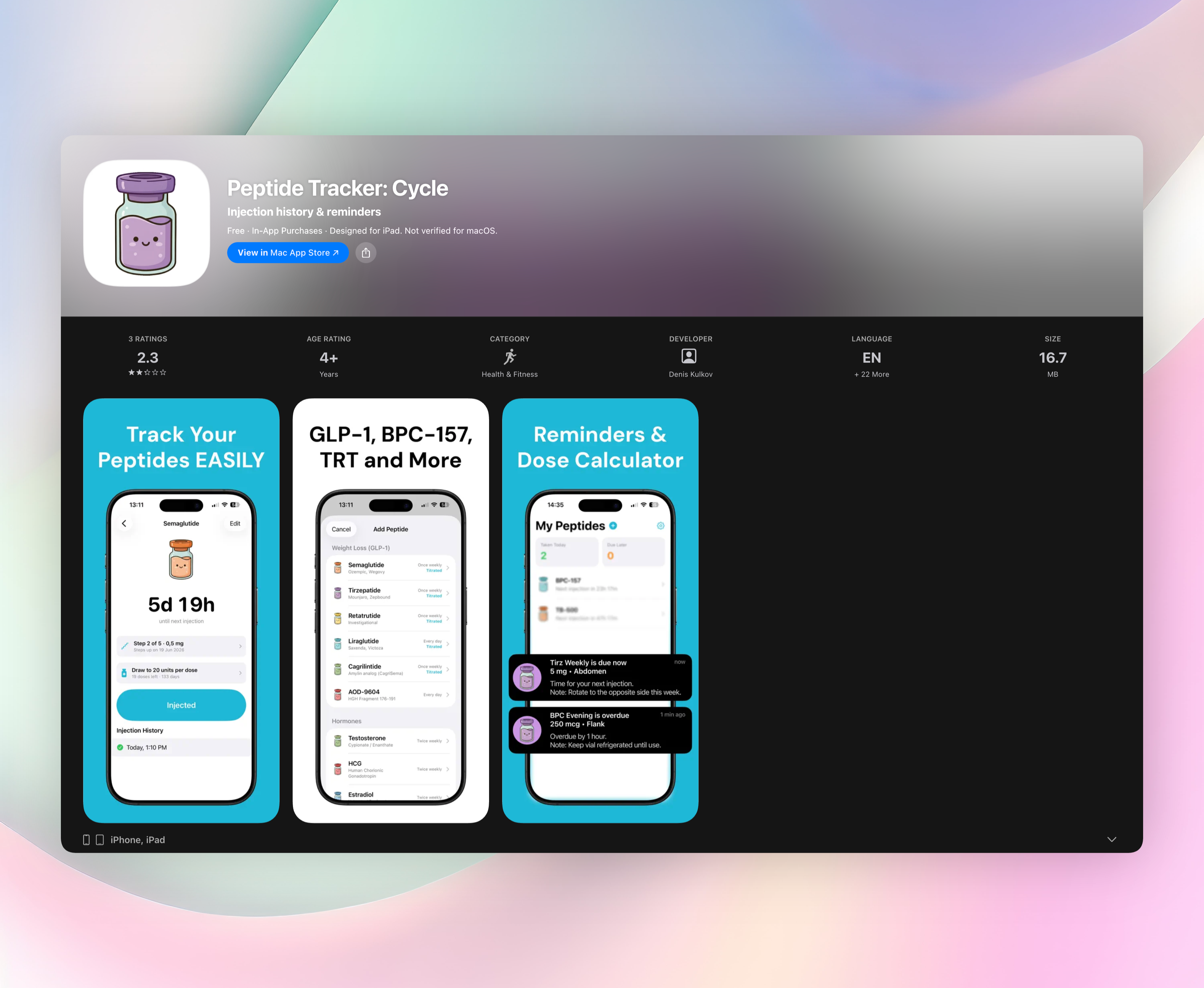
A written site map or an injection site rotation chart exists because rotation fails through memory, not intention. Rotating injection sites works when the order is recorded somewhere you actually look, and quietly collapses when it isn't. If you'd rather keep it with the rest of your records, Peptide Tracker is a peptide logging app for iPhone, and noting which site was used puts the rotation on record instead of in memory.
Rotation doesn't smooth out everything: regions absorb at different speeds. In insulin research the abdomen is generally fastest, then upper arm, thigh, and buttock. Staying inside one region holds that variable still. Depth is the other variable, set by needle length and gauge more than by technique.
Bruising and bleeding after a subcutaneous injection
Bruising after a subcutaneous injection usually means the needle clipped a small capillary. A single bead of blood at the puncture is ordinary. Press with clean gauze rather than rubbing, which spreads the leak and enlarges the mark.
Bleeding after a subcutaneous injection is more frequent for people on anticoagulants or antiplatelet drugs — expected, not a technique failure. A visible surface vein, pushing too fast, and liquid straight from the fridge all raise the odds, the last because cold stings and stinging makes people flinch.
A bruise announces itself by color: red, then purple, then a green-yellow fade. It's flat or barely raised, tender for a day or two, gone within about a week. That timeline separates it from a lump. If the ache feels deep and the site stays sore for days, the needle may have reached muscle — the subcutaneous versus intramuscular distinction is about depth, not location.
Lump, bruise, or reaction: telling them apart
| What you feel | How it looks | Timeline | Usual meaning |
|---|---|---|---|
| Soft, tender, discolored | Red → purple → yellow fade | Gone in about a week | Bruise from a nicked capillary |
| Raised and itchy, slightly warm | Pink wheal or blotch at the puncture | Settles within a day or two | Local injection-site reaction |
| Firm and rubbery, painless | Skin color normal, area looks fuller | Weeks to months, grows slowly | Lipohypertrophy or injection-site induration |
| Hot and increasingly painful | Spreading redness, tight skin | Worsens over 24–72 hours | Possible infection — same-day clinician |
When a lump becomes a clinician question
A raised area that hasn't softened after two weeks of complete rest, one that keeps growing, one that hurts, or anything hot and spreading belongs with a clinician, not a technique tweak — as does a lump somewhere you've never injected.
Resting a lipohypertrophic area is the standard remedy, and resting means stopping entirely, not using it less. Regression is slow — months, not weeks — and some long-standing areas never fully flatten. The part people miss is the handover: moving onto healthy tissue changes how much of an injection is absorbed, and for any prescribed injectable that's a conversation with the prescriber before the switch, not after.
FAQ
How far apart should injection sites be?
At least 1 cm between consecutive punctures is the bare minimum most formal guidance uses — that's under half an inch, so a full inch of spacing clears it comfortably and is easier to judge by eye. Work across a region in a grid instead of creeping back toward its center, and keep a couple of inches clear of the navel.
How long does lipohypertrophy take to go away?
Months, not weeks, and only if the area gets no injections at all in that time. Partial rest doesn't work, which is why catching it early matters more than fixing it later.
Is bruising after a subcutaneous injection normal?
Occasional bruising is normal and reflects a nicked capillary rather than bad technique. What isn't routine: bruising at nearly every injection, marks that keep enlarging after a day, or bleeding that takes minutes to stop — worth raising with a clinician, especially alongside blood thinners.
Can you feel lipohypertrophy before you can see it?
Usually. Palpation catches it well before the eye does, especially where the pad is wide and only slightly raised. Sweeping flat fingers across the region and comparing sides beats looking in a mirror.
Free Peptide tools
- BPC-157 & TB-500 Blend CalculatorEnter the BPC-157 and TB-500 amounts in your blended vial, the bacteriostatic water added and your desired BPC-157 dose. See the U-100 units, injection volume and TB-500 dose that comes with it.
- CJC-1295 Ipamorelin Blend CalculatorEnter the two peptide amounts in your blended vial, water added and the prescribed dose for either peptide. See the U-100 units, volume, both delivered amounts and doses remaining.
- Half-Life CalculatorEnter a starting amount, half-life, elapsed time and an optional repeat-dose interval to calculate amount remaining and decay milestones.
- mcg to mL CalculatorEnter a concentration, desired dose and syringe size to calculate the volume to draw in mL, U-100 units, mcg and mg.
- mg to mcg ConverterConvert mg to mcg or mcg to mg instantly. This simple calculator shows the converted amount and common reference values without giving dosing advice.
- Peptide Dosage CalculatorEnter your vial strength, the bacteriostatic water you added and the dose you were prescribed. Get the exact number of U-100 syringe units to draw, the injection volume and how many doses the vial holds.
- Semaglutide Units to mg CalculatorConvert prescribed semaglutide syringe units to mg, or a prescribed mg dose to U-100 units, using your vial details.
- Tirzepatide Unit CalculatorConvert your prescribed tirzepatide dose into U-100 syringe units, injection volume, concentration and doses remaining in the vial.