
What is a polypeptide? The chain-length ladder, dipeptide to protein
A polypeptide is a chain of amino acids joined end to end by peptide bonds — conventionally more than about 20 residues. Shorter chains have their own names: two residues make a dipeptide, three a tripeptide, and anything up to about twenty is an oligopeptide. A protein is a polypeptide folded into a working shape.
What is a polypeptide? Count residues, not amino acids
Every amino acid carries an amino group at one end and a carboxyl group at the other. Join the carboxyl of one to the amino group of the next, lose a molecule of water, and you have a peptide bond. What remains of each amino acid inside the chain is a residue — the amino acid minus the water it gave up. Peptide chemistry counts residues.
The arithmetic follows from that. A chain of n residues holds n − 1 peptide bonds, so two residues means one bond and three residues means two. When a paper calls something a "9-mer," it means nine residues, not nine bonds.
A polypeptide chain also has direction. The end with a free amino group is the N-terminus; the end with a free carboxyl is the C-terminus. Sequences are written N-terminus first, left to right, always. The backbone is unbranched — side chains hang off it, but it doesn't fork.
The chain-length ladder, from two residues to a folded protein
These names are conventions biochemists agreed on, not physical thresholds.
| Term | Residues | Peptide bonds | What the name is actually saying |
|---|---|---|---|
| Dipeptide | 2 | 1 | The shortest thing that can be called a peptide at all |
| Tripeptide | 3 | 2 | Still short enough to name residue by residue |
| Oligopeptide | ~2–20 | 1–19 | Oligo- means "few"; some texts cap it at 10, others at 20 |
| Polypeptide | ~20+ | 19+ | Poly- means "many"; describes the strand, folded or not |
| Protein | ~50+ | — | One or more chains in a defined three-dimensional structure |
Two caveats on that last row. A protein is defined by folding and function as much as by length, so the 50-residue line is a rule of thumb different sources move around. And "polypeptide" and "protein" aren't opposites: a single-chain protein is a polypeptide that has folded. If that boundary is what you came for, the wider peptide primer works through it properly. Most compounds called "peptides" sit far below that line anyway — a few residues up to roughly forty.
How a peptide sequence is written
Two notations do nearly all the work.
Three-letter codes, hyphenated, read N-terminus to C-terminus: Ala-Gly-Ser. Readable and unambiguous, which is why short sequences get spelled out this way in papers and on certificates of analysis.
One-letter codes, run together with no separators: AGS. The one-letter code exists because long sequences are unreadable hyphenated and hard to align by eye or by software. A 30-residue chain runs to about 120 characters in hyphenated three-letter notation and just 30 in one-letter code.
The twenty standard residues, grouped roughly by side-chain chemistry (groupings vary slightly between textbooks):
- Nonpolar / aliphatic: Ala (A), Gly (G), Ile (I), Leu (L), Met (M), Pro (P), Val (V)
- Aromatic: Phe (F), Trp (W), Tyr (Y)
- Polar, uncharged: Asn (N), Cys (C), Gln (Q), Ser (S), Thr (T)
- Basic: Arg (R), His (H), Lys (K)
- Acidic: Asp (D), Glu (E)
Nine of the letters don't match the first letter of the name, because the obvious letter was already taken. Alanine claimed A, so arginine got R and asparagine got N; glycine claimed G, so glutamate got E and glutamine got Q. The classic mnemonics bend the spelling on purpose — D for "aspar-D-ic acid," F for "F-enylalanine," W for the two fused rings of tryptophan — and the rest are just the nearest free letter.
Three more letters turn up in sequence files: X for an unknown or any residue, B for "Asn or Asp," and Z for "Gln or Glu." Those encode uncertainty in the read, not exotic amino acids. U (selenocysteine) and O (pyrrolysine) are genuine but rare.
Synthetic sequences rarely stop at the standard twenty, so a few annotations recur:
Ac-at the front: an acetylated N-terminus.-NH2at the end: an amidated C-terminus, as inAla-Gly-Ser-NH2.- A
D-prefix, or a lowercase letter: the mirror-image D-amino acid, not the usual L form. - A disulfide bridge noted between two Cys residues: a covalent link folding the chain back on itself.
None of those change the residue count, so the chain-length name stays the same whether the ends are capped or bare.
Why so many peptide compound names end in -tide
The suffix isn't styling. The World Health Organization assigns every international nonproprietary name a word-stem encoding the compound class, and -tide is the stem for peptide compounds. Anything carrying it was classified as a peptide when its generic name was granted. Other WHO stems mark specific peptide families the same way, without the -tide letters: -relin (GnRH-type peptides), -relix (their antagonists), -actide (ACTH analogs), -pressin (vasopressin analogs).
The word traces back to the Greek for "digested" — how these fragments were first met, as the pieces proteins break into.
What the suffix does not encode is length. A -tide name covers everything from a handful of residues upward and says nothing about where on the ladder above a given compound sits.
Where chain length shows up when you're handling the material
Molecular weight. Residue masses average roughly 110 Da — glycine's is about 57, tryptophan's about 186 — and a finished chain's mass is the sum of its residues plus about 18 Da for the capping water. A 30-residue chain therefore lands somewhere near 3,300 Da. That figure converts a molar amount into a mass, which is why two compounds at the same milligram number aren't the same molar quantity. When a label mixes mass units with activity units, how IU and mg relate explains where each one comes from.
Physical form. Longer chains have more bonds to lose and more ways to aggregate in solution, which is one reason this material is supplied freeze-dried rather than pre-dissolved; why peptides ship lyophilized covers what that process is protecting.
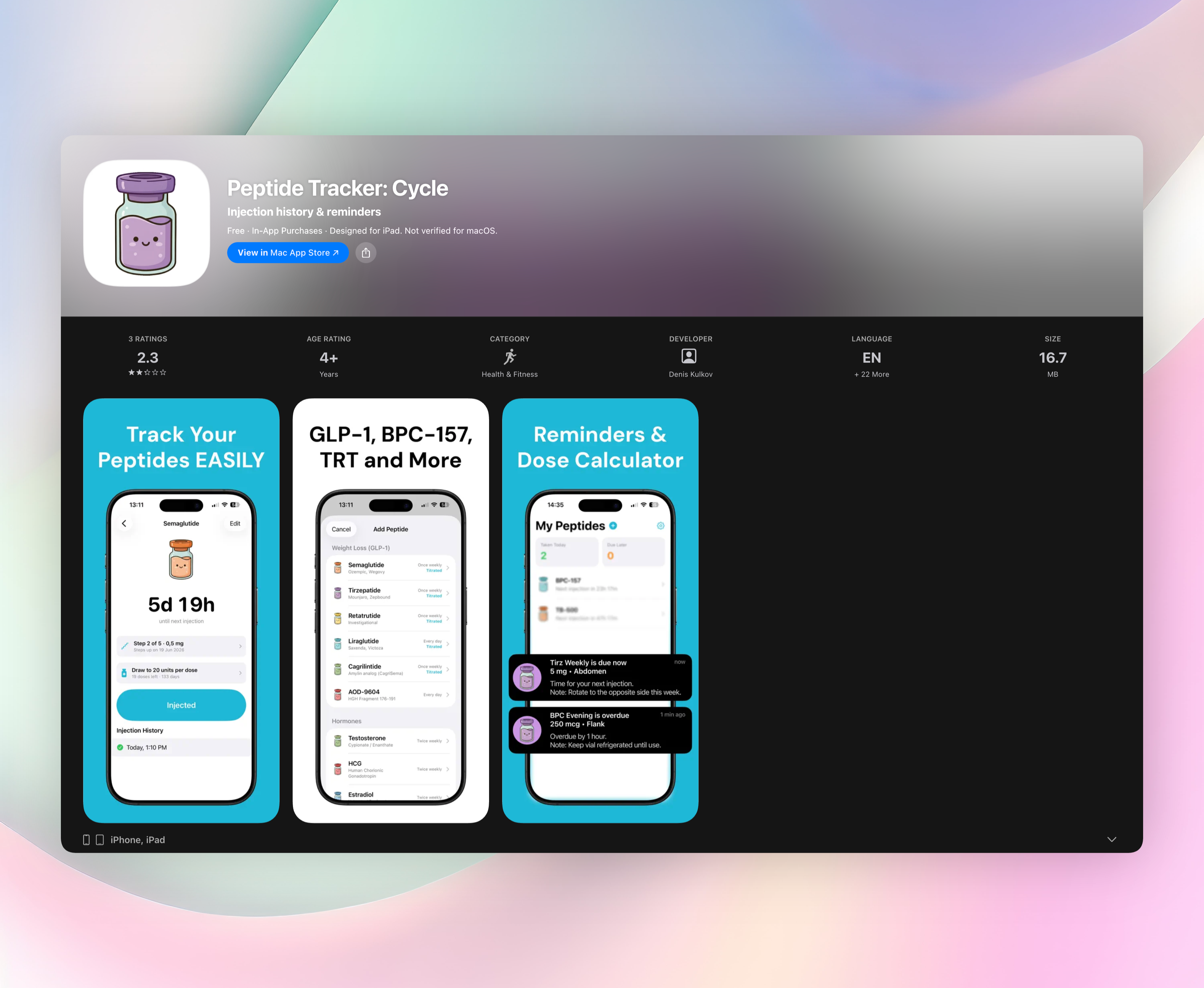
Notation on the label. A vial may carry a one-letter string while the paper you're reading spells everything out in three-letter form, and neither states the residue count outright. Writing the sequence and its length down once, beside the vial, saves deriving it again later. Peptide Tracker, a peptide logging app for iPhone, keeps a glossary of this vocabulary alongside each logged vial.
FAQ
Is a polypeptide the same thing as a protein?
Not quite. Every single-chain protein is a polypeptide, but not every polypeptide is a protein. "Protein" implies the chain has folded into a defined structure and does a job, and many proteins combine more than one chain. Length is only a proxy for that, which is why the 50-residue line stays a convention.
How many amino acids does it take to be called a polypeptide?
About 20 residues is the common cutoff, though 10, 20, and 50 all appear in different textbooks. Nothing physical happens at the boundary — it's shorthand for "long enough that naming each residue one at a time stops being practical."
What is the difference between a peptide and a polypeptide chain?
"Peptide" is the umbrella term for any amino acid chain shorter than a protein. The second phrase names the physical strand — the covalently linked backbone itself — which is why it shows up when describing the parts a protein is built from.
Why don't the amino acid one-letter codes match the first letters?
Several amino acids share a first letter. Alanine claimed A, so arginine and asparagine took R and N; glycine claimed G, so glutamate and glutamine took E and Q. The set favors zero ambiguity over memorability.
What does the -tide ending on a peptide name mean?
It's a World Health Organization nonproprietary-name stem for peptide compounds. It marks the compound class and nothing more — not the chain length, not the form it arrives in, not what it's for.
Free Peptide tools
- BPC-157 & TB-500 Blend CalculatorEnter the BPC-157 and TB-500 amounts in your blended vial, the bacteriostatic water added and your desired BPC-157 dose. See the U-100 units, injection volume and TB-500 dose that comes with it.
- CJC-1295 Ipamorelin Blend CalculatorEnter the two peptide amounts in your blended vial, water added and the prescribed dose for either peptide. See the U-100 units, volume, both delivered amounts and doses remaining.
- Half-Life CalculatorEnter a starting amount, half-life, elapsed time and an optional repeat-dose interval to calculate amount remaining and decay milestones.
- mcg to mL CalculatorEnter a concentration, desired dose and syringe size to calculate the volume to draw in mL, U-100 units, mcg and mg.
- mg to mcg ConverterConvert mg to mcg or mcg to mg instantly. This simple calculator shows the converted amount and common reference values without giving dosing advice.
- Peptide Dosage CalculatorEnter your vial strength, the bacteriostatic water you added and the dose you were prescribed. Get the exact number of U-100 syringe units to draw, the injection volume and how many doses the vial holds.
- Semaglutide Units to mg CalculatorConvert prescribed semaglutide syringe units to mg, or a prescribed mg dose to U-100 units, using your vial details.
- Tirzepatide Unit CalculatorConvert your prescribed tirzepatide dose into U-100 syringe units, injection volume, concentration and doses remaining in the vial.