
Are peptides steroids? Peptides vs steroids, explained
No — peptides are not steroids. Peptides are amino acid chains joined by peptide bonds; steroids are lipids built on a four-ring sterol skeleton derived from cholesterol. Different building blocks, different receptors, different clearance — nothing about one predicts the other.
Are peptides steroids? Two unrelated classes of molecule
The confusion is a vocabulary problem, not a chemistry one. Both arrive as vials and syringes, both get filed under "compounds," and both include molecules the body uses as hormones.
A peptide is amino acids strung together by peptide bonds — the same bond that builds every protein you've ever eaten. Chain length gets the naming: roughly two to twenty residues is an oligopeptide, longer chains are polypeptides, and past about fifty residues most people call it a protein instead. Those boundaries are conventions, not hard rules, and chain-length naming varies between sources.
A steroid isn't a chain at all. It's a fused ring system — three six-membered rings and one five-membered ring, seventeen carbons in the core, formally the gonane or cyclopentanoperhydrophenanthrene nucleus. Every steroid hormone your body makes sits on that skeleton with different groups attached: cortisol, aldosterone, testosterone, estradiol, progesterone, all assembled enzymatically from cholesterol. Anabolic-androgenic steroids are synthetic modifications of the same template.
The two aren't even distant cousins: a peptide is built monomer by monomer on a ribosome reading messenger RNA, while a steroid is built by enzymes modifying a cholesterol molecule. For the category from the ground up, what a peptide is covers the structure in more detail.
One more trap: in everyday speech "steroid" usually means anabolic-androgenic steroid, but corticosteroids — the anti-inflammatory kind — belong to the same chemical class. Both are steroids; neither is a peptide.
Peptide hormones vs steroid hormones, side by side
Nearly every peptides vs steroids difference falls out of one structural fact — chain versus ring system.
| Peptide hormones | Steroid hormones | |
|---|---|---|
| Built from | Amino acids, peptide bonds | Cholesterol, four-ring core |
| Solubility | Water-soluble | Fat-soluble |
| Travel in blood | Dissolved freely in plasma | Largely bound to carrier proteins |
| Receptor location | Cell surface | Cytoplasm or nucleus |
| Signal path | Second messengers (cAMP, IP₃, Ca²⁺) | Direct action on gene transcription |
| Typical onset | Seconds to minutes | Hours |
| Stored in advance | Yes, in secretory vesicles | No, synthesized on demand |
| Circulating half-life | Typically minutes | Typically much longer |
| Usual route when given as a drug | Injected | Oral or injected |
| Cleared by | Peptidases in plasma and tissue, kidney | Liver metabolism and conjugation, urine and bile |
| Body-made examples | Insulin, glucagon, oxytocin, vasopressin | Cortisol, testosterone, estradiol, aldosterone |
Where each one binds: outside the cell vs inside it
Peptides are hydrophilic. They dissolve in plasma and travel without a chaperone, but they can't cross the greasy interior of a cell membrane. So a peptide hormone binds a receptor on the outer surface of the cell — typically a G protein-coupled receptor or a receptor tyrosine kinase — and the message relays inward via second messengers such as cyclic AMP, IP₃, or calcium. That relay amplifies the signal, part of why peptide effects can appear in seconds to minutes.
Steroids do the reverse. Being lipids, they diffuse straight through the membrane and bind receptors sitting in the cytoplasm or the nucleus. The hormone-receptor complex acts on DNA directly, binding hormone response elements and changing gene transcription. Building new protein takes time, so steroid effects appear over hours, not seconds. Rapid non-genomic steroid effects at membrane sites exist too — the textbook split is an approximation, not an absolute law.
That receptor location also explains the storage row in the table: peptide hormones can be made ahead of time and held in secretory vesicles until a signal triggers exocytosis, while steroid hormones would diffuse straight out of any vesicle, so cells synthesize them on demand instead.
Why peptides get injected and many steroids can be swallowed
Your digestive tract is built to destroy peptides. Pepsin in the stomach, trypsin and chymotrypsin from the pancreas, and peptidases on the intestinal brush border all hydrolyze peptide bonds into short fragments and free amino acids. A swallowed peptide hormone is, to your gut, food. Whatever survives runs into a second obstacle: peptides are large and water-loving, and the gut lining absorbs them poorly.
Injection sidesteps both problems, placing the intact molecule into tissue where it reaches circulation without passing through the gut. Some peptide drugs have been engineered into oral forms using absorption enhancers or protease-resistant modifications, but oral bioavailability for peptides stays low, so injection remains the default.
Steroids face the opposite problem. They're small and fat-soluble, so the gut wall is no obstacle — the liver is: unmodified testosterone is largely metabolized on first pass through it. The classic workaround is 17α-alkylation, a modification that slows hepatic breakdown enough for an oral form to survive — and long documented as hard on the liver. Injectable esters take the other route, releasing slowly from an oil depot.
How the body clears each one
Peptides are taken apart by the same machinery that handles any protein. Peptidases in blood and tissue cleave them, and the kidney filters and degrades small peptides efficiently. The result is short circulating half-lives, often just minutes for native peptide hormones. Anything meant to last longer has to be engineered for it — modified peptides protect the vulnerable ends of the chain or carry groups that bind albumin.
Steroids clear through the liver instead. Being fat-soluble, they can't simply be filtered into urine; the liver first conjugates them with glucuronic acid or sulfate to make them water-soluble, then they leave in urine and bile. Carrier proteins in the blood — sex hormone-binding globulin, corticosteroid-binding globulin, albumin — hold much of the circulating pool in a bound reservoir shielded from clearance, a big reason steroid half-lives run long next to peptides.
What are peptide hormones? Examples your body already makes
The category sounds exotic until you list it — peptide hormone examples:
- Insulin — 51 amino acids in two chains held together by disulfide bridges, from pancreatic beta cells.
- Glucagon — 29 amino acids, from pancreatic alpha cells, and insulin's counterweight in glucose regulation.
- Oxytocin and vasopressin — nine amino acids each. These two nonapeptides differ at only two positions yet do entirely different jobs.
- Adrenocorticotropic hormone (ACTH) — 39 amino acids, released by the pituitary.
- Parathyroid hormone — 84 amino acids, central to calcium handling.
- Growth hormone — 191 amino acids, long enough that "protein hormone" is the more accurate label.
The standard textbook split isn't two classes but three: peptide and protein hormones, steroid hormones, and amine hormones built from single amino acids — thyroid hormones and the catecholamines. Thyroid hormone is the awkward case, since it's an amino acid derivative that nonetheless crosses membranes and works through nuclear receptors like a steroid does. "Crosses the membrane" is a steroid trait, not a steroid definition.
Why the distinction shows up in handling
Structure dictates storage. Peptide bonds hydrolyze in water, and peptide chains lose their working shape with heat, agitation, and repeated freeze-thaw cycles. That's why so many peptides are shipped as lyophilized powder, reconstituted with a diluent, and then kept cold with a limited usable window. A steroid in oil is far more forgiving of room temperature and time. Same syringe, different rules — mixing the two mental models ruins vials.
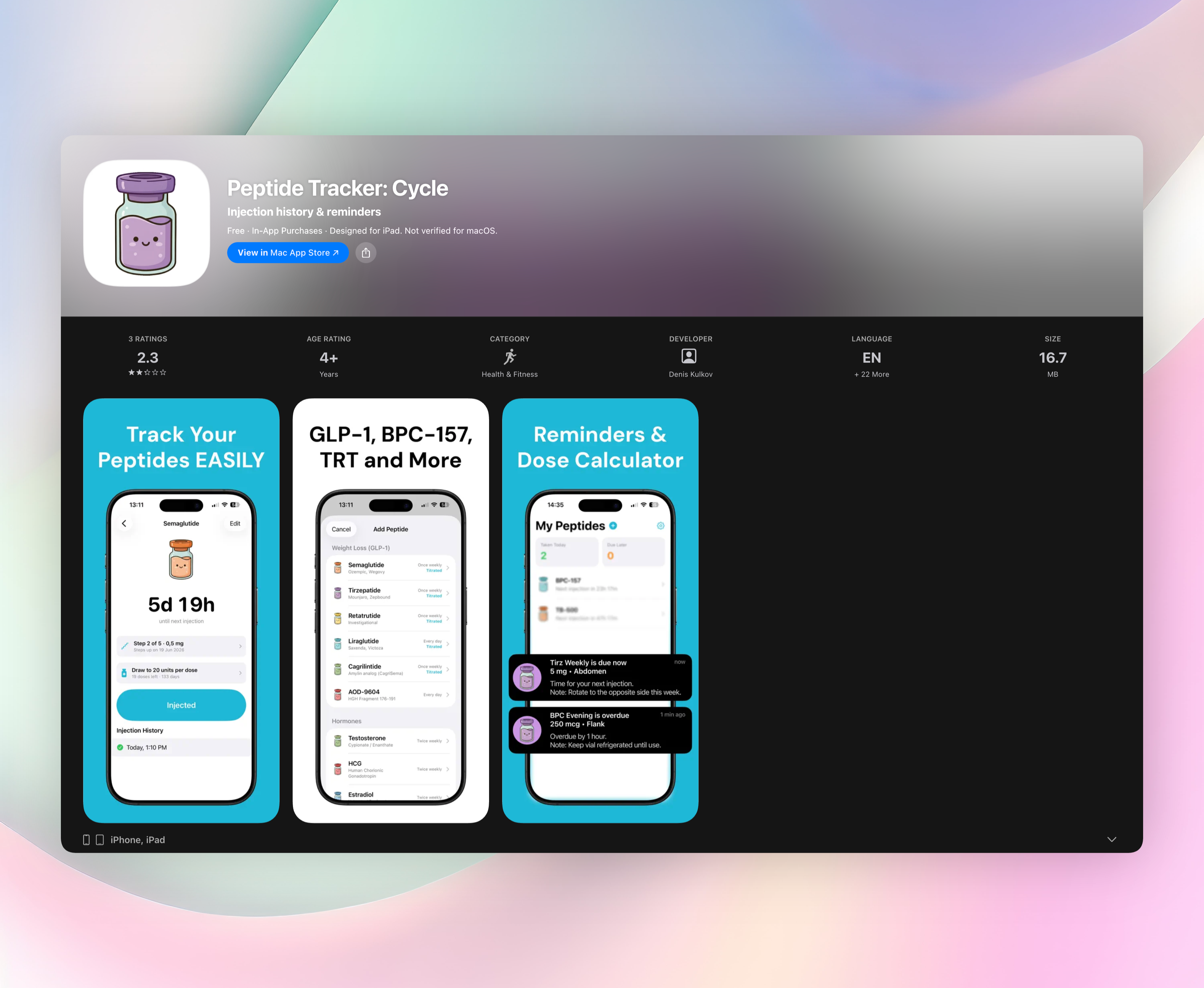
If you're keeping records across vials, reconstitution dates, and concentrations, Peptide Tracker is a peptide logging app for iPhone. It logs what you record and makes no claims about what any compound does.
FAQ
Is a peptide hormone a steroid hormone?
No. A peptide hormone is a chain of amino acids; a steroid hormone is a cholesterol-derived molecule with a four-ring core. They're separate classes in any hormone taxonomy, signaling through different mechanisms — cell-surface receptors versus intracellular ones.
Are peptides and steroids both hormones?
Some members of each class are hormones, but neither word means "hormone." Peptide and steroid describe chemical structure. Plenty of peptides are enzyme fragments, antibody fragments, or protein leftovers, and plenty of steroids are structural molecules — cholesterol included.
Why can't peptides be taken as a pill?
Digestive enzymes hydrolyze peptide bonds, so an oral peptide is largely broken down before absorption, and what remains crosses the gut wall poorly. Oral formulations exist for a few peptide drugs, using absorption enhancers or structural modifications, but bioavailability stays low.
Do peptides and steroids act on the same receptors?
No. Peptides bind receptors on the cell membrane and trigger second-messenger cascades inside the cell. Steroids cross the membrane and bind receptors in the cytoplasm or nucleus, where the complex regulates gene transcription directly.
Are collagen peptides the same thing as peptide hormones?
Structurally they're the same class — amino acid chains joined by peptide bonds — but they aren't hormones. Collagen peptides are protein fragments from broken-down collagen; a peptide hormone is a specific sequence the body makes to signal a target tissue.
Free Peptide tools
- BPC-157 & TB-500 Blend CalculatorEnter the BPC-157 and TB-500 amounts in your blended vial, the bacteriostatic water added and your desired BPC-157 dose. See the U-100 units, injection volume and TB-500 dose that comes with it.
- CJC-1295 Ipamorelin Blend CalculatorEnter the two peptide amounts in your blended vial, water added and the prescribed dose for either peptide. See the U-100 units, volume, both delivered amounts and doses remaining.
- Half-Life CalculatorEnter a starting amount, half-life, elapsed time and an optional repeat-dose interval to calculate amount remaining and decay milestones.
- mcg to mL CalculatorEnter a concentration, desired dose and syringe size to calculate the volume to draw in mL, U-100 units, mcg and mg.
- mg to mcg ConverterConvert mg to mcg or mcg to mg instantly. This simple calculator shows the converted amount and common reference values without giving dosing advice.
- Peptide Dosage CalculatorEnter your vial strength, the bacteriostatic water you added and the dose you were prescribed. Get the exact number of U-100 syringe units to draw, the injection volume and how many doses the vial holds.
- Semaglutide Units to mg CalculatorConvert prescribed semaglutide syringe units to mg, or a prescribed mg dose to U-100 units, using your vial details.
- Tirzepatide Unit CalculatorConvert your prescribed tirzepatide dose into U-100 syringe units, injection volume, concentration and doses remaining in the vial.