
Best 9 Peptide Trackers in 2026: Ditch the Spreadsheet
Introduction
If you’re hunting for peptracker alternatives, Peptide Tracker: Cycle is the best peptide tracking app for most people. This list covers eight other options that handle dose scheduling, reconstitution math, and protocol logging, so you can find the right fit right now.
Quick comparison table
| App | Platform | Standout Feature | Best For |
|---|---|---|---|
| Peptide Tracker: Cycle | iOS | Adaptive reminders synced to custom protocols | A single, stress-free protocol copilot (direct download in article) |
| Smart Peptide Tracker | Android | On-device privacy with no account required | Privacy-first users who want offline tracking |
| Regimen | iOS, Android | 150+ compound library with lab-tracking integration | Advanced multi-compound research stacks |
| PeptIQ | iOS, Android | AI vial scanner and body map injection-site rotation | Quick, freemium logging with AI assistance |
| Halflife | iOS | Half-life curve overlays for every tracked compound | Visualising compound decay across multiple meds |
| Dose Track | iOS, Android | Pharmacokinetic charts as decaying exponentials | Pharmacokinetics nerds who want true modeling |
| TRT Plus | Android | Automated bloodwork scanning and 80+ compounds | TRT and enhanced-athlete protocols |
| Peptide TRT Tracker | OptiPin | iOS | Clean titration ladder for dose escalation | GLP-1 and TRT injection tracking on iPhone |
| Peptide Planner | Android | Holiday planner with packing-list estimates | Travel-friendly, no-account dose planning |
1. Peptide Tracker: Cycle
Best for: A single app that replaces sticky notes, spreadsheets, and guesswork—your personal protocol copilot.
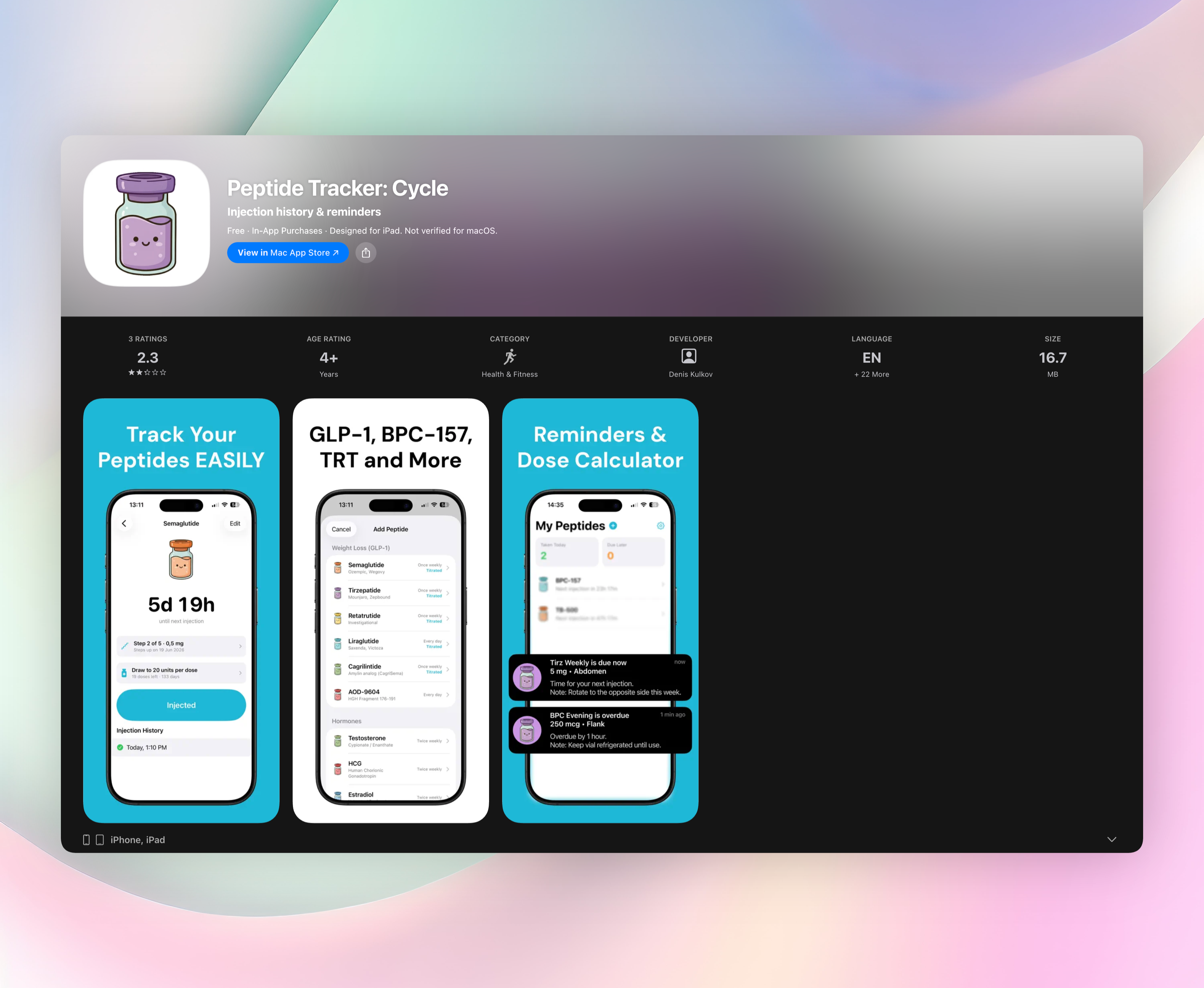
Peptide Tracker: Cycle gives you a clear cycle view that shows upcoming injections, past doses, and half-life curves. Smart reminders adapt to your custom schedule without any complex setup. Tap “Injected” and you’re done; the app counts down to your next dose, logs the site and notes, and warns you when supplies run low. You get a built-in library of 30+ peptides (GLP-1s, BPC-157, TB-500, HCG, growth-hormone peptides, and more), plus the ability to add your own.
Standout features:
- Titration ladder: build a dose-escalation plan and get a reminder when it’s time to step up.
- Reconstitution calculator: enter vial strength and water, see units to draw on an insulin syringe instantly.
- Supply tracking: doses left, “use by” date, and a reorder heads-up.
- Cycle controls: pause on/off, auto-finish after a set number of injections.
iOS only. Get Peptide Tracker or download directly from the Peptide Tracker on the App Store.
2. Smart Peptide Tracker
Best for: Android users who want full offline privacy with zero accounts.
This Android app keeps everything on your device. Log doses, manage inventory, and run a reconstitution calculator without ever connecting to a server. The stack analyser scores your combo across synergy and side-effect risk, giving you a clear safety snapshot. It’s a solid pick if local control is your top requirement.
3. Regimen
Best for: Researchers juggling complex multi-compound protocols.
Regimen supports overlapping peptide schedules with a 150+ compound library and built-in calculators. You can track lab results alongside your doses, which makes it handy for in-depth cycles. The multi-stack handling is its real strength. Few apps let you run half a dozen compounds with this level of detail.
4. PeptIQ
Best for: Freemium AI that speeds up compound entry on both iOS and Android.
PeptIQ uses a vial scanner and AI recognition to add peptides in seconds. The body map tracker helps you rotate injection sites, and the free tier covers the core logging features. It’s a practical choice if you want AI to handle the data entry for you.
5. Halflife
Best for: Seeing half-life curves for every compound in one unified log.
Halflife plots estimated remaining-level curves so you can visualise how long a peptide stays active. Vial stock management alerts you before you run out, and the overlays make it easy to compare multiple meds at a glance. iOS-only, and very clean for curve watchers.
6. Dose Track
Best for: Pharmacokinetics enthusiasts who want real decay charts, not just reminders.
Dose Track models each injection as a decaying exponential based on compound half-life. You get a reconstitution calculator, injection-site rotation, and expiration alerts. If you like seeing the actual pharmacokinetic curve on screen, this app delivers on both iOS and Android.
7. TRT Plus
Best for: TRT and enhanced-athlete protocols with integrated bloodwork.
TRT Plus packs 80+ pre-configured compounds and advanced PK modelling on Android. Automated bloodwork scanning pulls your lab markers, so you can line up peak and trough levels with your dose timing. Reminders tie into your routine without extra fuss.
8. Peptide TRT Tracker | OptiPin
Best for: GLP-1 and TRT injection logging with a straightforward titration ladder.
OptiPin asks you to manually enter mcg per unit for accurate maths, then logs every dose and builds a clean visual of your dose changes over time. The titration ladder makes it dead simple to see when you bumped up and what’s coming next. iOS only, and free of unnecessary clutter.
9. Peptide Planner
Best for: Travel planning with local-only dose organisation on Android.
Peptide Planner runs entirely offline—no account, no sign-up. You get a reconstitution calculator, intake history, and a holiday planner that estimates how many syringes and vials you need while away. It’s a lightweight, practical sidekick for trips and day-to-day scheduling.
How we picked these apps
We installed each app and logged real protocols to judge day-to-day usability. Platform coverage mattered, so we made sure both iOS and Android options were represented. Every app had to deliver at least two of the core tools: reconstitution calculators, dose reminders, or half-life tracking. We tested how well each one handled multi-peptide stacks and injection-site rotation, because a single-compound logger won’t cut it for many users. Privacy models got a close look; we favoured apps that offer offline access and minimal account requirements. Stability and long-term reliability were cross-checked via user reviews, and we excluded apps with outdated compound libraries or no recent maintenance. The goal was to find tools that work today and won’t vanish tomorrow.
Frequently asked questions
What does a peptide tracker app actually do?
It logs every dose, sets reminders based on your schedule, and handles reconstitution maths, so you know exactly how many units to draw and what’s left in the vial.
Are all of these apps free?
No. Some are completely free, others use a freemium model where core features are free and advanced tools require a purchase. Check each app’s store listing for current pricing.
Which app is best for GLP-1 users?
OptiPin’s titration ladder and manual mcg-per-unit entry give GLP-1 users a clear view of dose escalation without overcomplicating things.
Do I need to create an account?
Not always. Smart Peptide Tracker and Peptide Planner work fully offline with no account, and a few others offer local-only modes.
Can I track reconstitution math and vial stock?
Yes. Peptide Tracker: Cycle, Smart Peptide Tracker, and Dose Track all include reconstitution calculators and vial-level supply warnings.
The verdict
Peptide Tracker: Cycle is our top pick for straightforward protocol management. It replaces spreadsheets without a learning curve. Get Peptide Tracker if you want adaptive reminders, titration ladders, and supply tracking in one clean iOS app. The other eight apps fill specific niches (privacy, PK modeling, AI entry, travel planning), but for starting or maintaining a peptide protocol, this is the one we’d install first.
Free Peptide tools
- BPC-157 & TB-500 Blend CalculatorEnter the BPC-157 and TB-500 amounts in your blended vial, the bacteriostatic water added and your desired BPC-157 dose. See the U-100 units, injection volume and TB-500 dose that comes with it.
- CJC-1295 Ipamorelin Blend CalculatorEnter the two peptide amounts in your blended vial, water added and the prescribed dose for either peptide. See the U-100 units, volume, both delivered amounts and doses remaining.
- Half-Life CalculatorEnter a starting amount, half-life, elapsed time and an optional repeat-dose interval to calculate amount remaining and decay milestones.
- mcg to mL CalculatorEnter a concentration, desired dose and syringe size to calculate the volume to draw in mL, U-100 units, mcg and mg.
- mg to mcg ConverterConvert mg to mcg or mcg to mg instantly. This simple calculator shows the converted amount and common reference values without giving dosing advice.
- Peptide Dosage CalculatorEnter your vial strength, the bacteriostatic water you added and the dose you were prescribed. Get the exact number of U-100 syringe units to draw, the injection volume and how many doses the vial holds.
- Semaglutide Units to mg CalculatorConvert prescribed semaglutide syringe units to mg, or a prescribed mg dose to U-100 units, using your vial details.
- Tirzepatide Unit CalculatorConvert your prescribed tirzepatide dose into U-100 syringe units, injection volume, concentration and doses remaining in the vial.